AI in Mining: When Software Buys the Mine

Cicero Campelo, CISSP
August 24, 2026 · 13 min read
Part of our guide to AI for startups.
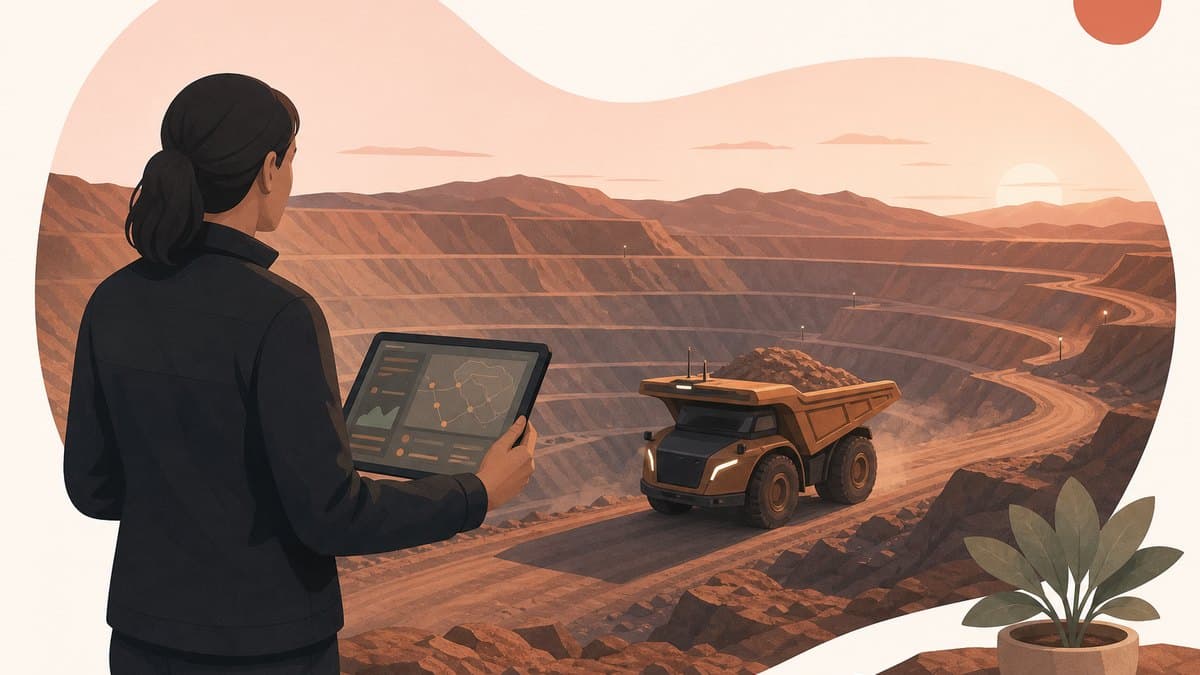
Table of contents
- What AI in mining actually looks like on a working site
- Why AI in mining stalls: the bottleneck is coordination, not geology
- Why the software company had to buy the mine
- Start where the paper cuts are
- Deploy on two trucks, not the whole fleet
- Leverage, not replacement
- Autonomy turns a mine into an attack surface
- The case against copying this
- What AI in mining teaches founders in any physical industry
- What to do this week
- Sources
- Frequently asked questions
AI in mining means machine perception and autonomy running the parts of a mineral operation that people used to run by hand: driverless haul trucks, autonomous drills, robots collecting readings, models tuning the refining circuit. Search the phrase and you get that list from a dozen consultancies, all accurate, none of it telling you why so little of it is actually running on a site somewhere.
The interesting question is not what AI can do in mining. It is why the industry that most obviously needs it has been the slowest to take it, and what one company decided to do about that.
Mariana Minerals is a software-first, vertically integrated minerals company co-founded in 2024 by Turner Caldwell, who studied mechanical engineering at Stanford and spent close to a decade at Tesla, his last role there running its lithium, nickel, and battery recycling programs. In an a16z American Dynamism film, Caldwell describes the pattern he was matching against: "If you look at the big industrial sectors, so you have automotive and Tesla took that on. You have the space industry and SpaceX took that on." Minerals, he argues, is the one nobody has taken on with modern technology applied holistically.
The conclusion Mariana drew was not to sell software to mining companies. As the thesis is put in the film, "you have to be a vertically integrated software first minerals mining and refining company." That is a strange sentence for a software company to commit to, and the reasoning behind it is the most transferable thing in this story.
What AI in mining actually looks like on a working site
Skip the abstraction and look at one site.
In Q4 2025 Mariana acquired Lisbon Valley Mining Company, a roughly 10,000-acre permitted land package in San Juan County, Utah that had produced high-purity copper cathode since 2009. Mining had been paused in late 2024 while the refinery kept running. In April 2026 the company restarted the mine as Copper One with autonomous systems active from day one.
What runs there:
- Autonomous haulage. Pronto's system drives the haul trucks with camera-based machine learning and satellite navigation, and retrofits across mixed equipment fleets rather than requiring one manufacturer. TechCrunch reported the deal in April 2026, the first for Pronto after its acquisition by Travis Kalanick's Atoms.
- Autonomous drilling. Sandvik's AutoMine platform runs production drilling, with operators monitoring multiple surface machines at once from a remote control room.
- Robotic sensing. Boston Dynamics Spot quadrupeds patrol the open pit, the heap leach pad, and the solvent extraction and electrowinning circuit where the copper is actually refined.
- The layer that matters. MarianaOS, split into MineOS, PlantOS, and CapitalProjectOS, coordinates all of it. PlantOS pulls solution chemistry, flow rates, temperature, and cell performance into one control system and runs models against them.
Notice that three of those four are bought from someone else. The autonomy hardware is not the moat. The company's own description is blunt about it: what makes the site unusual is not any single piece of autonomous equipment but the intelligence layer coordinating them.
That is the same structural lesson as AI for manufacturing, where the sensing and acting layers are commoditizing faster than the layer that decides what to do with them. The difference is what Mariana did when it found out the coordination layer had nowhere to run.
Why AI in mining stalls: the bottleneck is coordination, not geology
The West did not forget where the copper is. In the film, the point is made that the United States was once one of the largest producers of lithium and copper and then shifted away from making these metals itself. Another voice adds: "We didn't just lose the capability. We actually fell meaningfully behind."
Demand is not the constraint either. S&P Global projects global copper demand reaching 42 million metric tons a year by 2040, up from 28 million in 2025, driven by AI, defense, and robotics on top of ordinary consumer demand, with supplies expected to fall short by more than 10 million metric tons a year without more mining and recycling. The IEA's Global Critical Minerals Outlook puts supply concentration and copper adequacy at the front of the energy and national security agenda, and records base metal prices rising by a third between January 2025 and April 2026, with copper at record highs. A speaker in the film puts the industry's response bluntly: "there's a lot of worry about that, but there's no clear reaction by the Western mining companies in particular that actually go do it."
So what is in the way? a16z's investment note, written by Erin Price-Wright and Ryan McEntush, gives the answer in one line: the bottleneck in expanding minerals production is not geology, it is coordination. Operations run on Excel files passed between engineering contractors, regulators, and owners, on static mine plans, and on decisions made long after the data was available.
That is not a colorful metaphor. From the film, on taking over the Utah site: "Every day for about 150 days, we found a new spreadsheet that was being used to run the operation. And that's just how the industry runs."
About a hundred and fifty days of finding a new spreadsheet is a very precise description of a coordination failure, and it is the same failure a founder meets in logistics, construction, healthcare scheduling, and every industry where the system of record is really a folder of spreadsheets. The work is not automating any one of those files. It is that nobody can see the whole operation at once, so every decision is made late and with partial information.
Why the software company had to buy the mine
Here is the part worth stealing.
The obvious business is to sell the coordination layer to mining companies. a16z's note explains why that does not work: software that sits siloed inside a traditional mining company cannot be absorbed, because the company is not organized to change how it decides things. Software built natively inside an operator compounds instead, because each new site produces more data and operational insight that drives down the cost and timeline of the next one.
Mariana did not plan the Utah acquisition as a strategy deck. It arrived through the side door. The team was hired as consultants to review the operation and think about how to do things differently, worked with the owners for four or five months, studied the assets, and looked for remaining potential. Then, in the film's telling, they said: "instead of consulting, why don't you guys buy and run this thing?" The response was not a valuation model. It was "It's a great sandbox for what we want to do."
Generalize that carefully, because the wrong lesson is "buy your customer." The right one is a test you can run on your own product this week:
If your product only pays off once the customer reorganizes itself, you do not have a customer. You have a prospect who has to become a different company first.
When that is true, you have three honest options. Narrow the product until it delivers value without the reorganization, which is why inspection and sensing tools deploy years before control tools. Sell to whoever is already organized that way, usually a newer operator with no legacy to defend. Or become the operator. Mariana took the third, and it is the most expensive one.
This is the counterweight to the usual advice on building a moat with AI. Owning the workflow is a stronger position than selling into it, but you pay for it in capital, in operational risk, and in a hiring problem that has nothing to do with software.
Start where the paper cuts are
The product definition Mariana uses is the best line in the film, and it applies to any operations software: "It's not software for software's sake, but it's software that solves every single one of those tiny paper cuts a thousand times a day across a thousand different people."
A site operator who started at the mine in 2005 describes what those paper cuts were before: "writing stuff on papers, and then taking those papers and entering the data on a spreadsheet." Not a dramatic failure. Just a small tax, collected thousands of times a day.
That is a different specification from the one most AI founders write. Most start from the hardest decision in the workflow and try to automate it, because the hardest decision is the most impressive demo. The paper-cut framing starts from the highest-frequency friction instead, which is usually data entry, handoff, and reconciliation, and it earns the right to the hard decision later by owning the data those thousand small interactions produce.
It is also the difference between software people tolerate and software people use when nobody is watching. A model that makes one important call per week can be ignored. A system that removes an annoyance from every shift changes behavior, and behavior change is what generates the training data for everything after.
Deploy on two trucks, not the whole fleet
The most portable operating decision in the film has nothing to do with mining.
Mariana went after autonomous haulage on two haul trucks, deliberately, as fast as it could. The industry norm described in the film is the opposite: a quarry or mine takes about two years to convert, across a fleet of 30, 50, or 100 trucks. And the reason given for rejecting that approach is the sentence founders should write down: "you don't get the contact with the real world that you need to understand like what is actually going to break."
Two trucks is not a smaller version of a hundred trucks. It is a different instrument. It produces failure information in weeks instead of years, at a cost where failure is survivable, and it puts the people who fix the problems in the same room while the problems are still fresh.
That is the same argument behind shipping an AI feature to a narrow slice of production rather than perfecting it in staging, and behind building evals from real usage instead of from imagined inputs. In physical AI the stakes are higher and the temptation to simulate everything is stronger, which is exactly why the discipline matters more. Simulation tells you whether your model is right about the world you imagined. Two trucks tell you which part of the world you failed to imagine.
The version of this mistake in software is a twelve-month platform build before a single customer touches it. The version in hardware is a two-year fleet conversion. Both are the same error: buying certainty with time you cannot get back.
Leverage, not replacement
The framing Mariana uses for what the software is for is worth quoting because it is unusually specific: the purpose is "not to replace people, it is to give them leverage and to give them an expanded impact." And the operating question underneath: "how do we make a really small talented team do much much more with a lot less."
That is the revenue per employee argument arriving in an industry where it has never really applied. It is also not a public relations line in this case, because the site's economics depend on it. The same operator quoted above notes that San Juan County is the poorest county in Utah, and describes success as producing more copper profitably, expanding, and keeping people in the area employed for a long time.
Founders selling into physical industries usually get this backwards. The pitch that lands in a boardroom is headcount reduction. The pitch that survives contact with the actual site, where the people running the equipment decide whether your system gets used properly or worked around, is that the crew gets to do more with the same number of people. In an operation where a workaround is invisible to you and obvious to them, that distinction is not diplomacy. It is deployment risk.
Autonomy turns a mine into an attack surface
Here is the part the use-case lists leave out, and it is the part I would want a security review on before day one.
An autonomous mine is a network. Driverless trucks navigate by satellite positioning and camera models. Drills are supervised from a remote control room. Robots move sensor data continuously off the pit and the refinery circuit into a central platform. Every one of those is a control path that used to be a person in a cab, and control paths have properties that dashboards do not.
Four things follow, and they generalize to any founder putting software in charge of machinery:
- Satellite navigation is a trusted input you do not control. Positioning signals can be degraded or spoofed, which is a well-documented risk class in aviation and maritime operations. Anything that acts on position needs plausibility checks against independent sensing, not blind trust in one source.
- Retrofit means you now own the safety case. An autonomy system that fits across mixed fleets is commercially excellent and means the safety-critical control path is software you integrate, on equipment its manufacturer did not design for it. That boundary is where responsibility gets fuzzy and where incidents live.
- The remote operations center concentrates risk. Supervising several machines from one room is the productivity win and, by the same design, a single point of failure. Ask what happens on a network partition, and make sure the safe state is the default rather than the exception.
- Operational technology and IT are now one network. Pulling refinery chemistry and flow data into a central platform is what makes optimization possible, and it also connects a process control environment to a corporate one. Segment it, log across the boundary, and know which side an incident started on.
None of this is a reason not to build. It is a reason to write down the failure modes before the fleet grows, in the same spirit as the compliance and governance work that founders postpone until an enterprise buyer forces it. The cost of doing it at two trucks is a design conversation. The cost at a hundred is a program.
The case against copying this
Be honest about what this playbook costs, because the story reads more repeatable than it is.
Mariana raised a $310 million Series B led by Khosla Ventures in August 2026, after an a16z-led Series A in July 2025 that brought its total raised to $85 million, with seed investors Breakthrough Energy Ventures and Khosla Ventures participating. It acquired an already-permitted operation with a refinery that had been running since 2009, which removed the single hardest and slowest part of building a mine. Its stated target is 10 mineral projects in 10 years against an industry norm a16z puts at twelve years for one lithium project. Those are not startup numbers, and permitting, environmental review, and community relations are not problems software makes go away.
So the transferable part is not the capital structure. It is the diagnosis: the reason the industry has no AI is not that the models are missing, it is that the buyer cannot deploy them. That diagnosis is free, and running it on your own market costs you an afternoon.
The other honest caveat is time. A software company can ship weekly. A mine ramps over quarters, and the feedback loop that makes the software better is bounded by how fast rock actually moves. That clock is the defining constraint on deep tech startups generally, and founders who thrive on shipping velocity should look hard at whether they want a loop measured in seasons.
What AI in mining teaches founders in any physical industry
Three things generalize past copper.
The hard part is no longer writing the software. Y Combinator's What Actually Makes A Startup Durable makes the case that a startup now needs a genuinely hard component, because producing a lot of software is not it. A mine is an unusually literal version of that. So is a refinery, a plant, a field, and a fleet.
The world of atoms is where the unclaimed problems are. YC's The GPT Moment for Robotics Is Here argues that after years of everyone concentrating on the digital world, the physical one is now the place to be looking, and YC's New Operating Systems for the Physical World frames the opportunity as coordinating AI agents, robots, and people together rather than deploying any one of them.
You will end up owning both halves. The film closes on the point directly: to build something that changes the course of civilization "you have to do things in the physical world," and "it's the combination of the atoms and the bits that enables that." Not an atoms company, not a bits company. The founders who win these markets are the ones willing to be bad at one of them for a while.
What to do this week
- Run the absorption test on your product. Write down what the customer has to change about themselves before your product delivers value. If the list has more than one item, you are selling a reorganization, not software.
- Find your spreadsheet count. Ask a customer how many spreadsheets run their operation. If nobody knows the number, that gap is the product, and it is worth more than the model you were planning to build.
- Pick the paper cuts before the hard decision. List the frictions that happen a thousand times a day, not the one judgment call that happens weekly. Ship against the first list and earn the data for the second.
- Cut your next pilot to two units. Two trucks, two stores, two clinics, two accounts. Choose the size where real-world failure arrives in weeks and is survivable, and put the people who fix things in the same room.
- Write the failure modes down before you scale. For anything acting on the physical world: what happens on a lost network, a spoofed sensor, a stale model. Do it at two units, when it is a conversation instead of a program.
- Re-pitch as leverage, not headcount. Rewrite your value proposition for the person operating the equipment, not the person approving the budget. They decide whether your system is used properly or worked around.
Deciding which layer to enter, what to own, and where a human stays in the loop is the operating question underneath all of this, and it is exactly what the AI Operating System for Startups course is built around. The wider map of how this fits alongside product, engineering, pricing, and team is in our guide to AI for startups.
Sources
- The Future is Metal - Mariana Minerals (a16z American Dynamism), the film this article distills.
- Mariana Minerals restarts Copper One (April 2026), for the site details, the autonomy stack, and the MarianaOS subsystems.
- Investing in Mariana Minerals (a16z), for the coordination thesis and the project timeline comparison, by Erin Price-Wright and Ryan McEntush.
- Profile: Turner Caldwell, co-founder and CEO of Mariana Minerals.
- Funding: Fortune on the $310 million round led by Khosla Ventures.
- Autonomy partnership: TechCrunch on Pronto's autonomous haulage at the Utah mine.
- Copper demand: Reuters on S&P Global's Copper in the Age of AI report, and the IEA Global Critical Minerals Outlook on supply concentration and prices.
- What Actually Makes A Startup Durable (Y Combinator), for the argument that a startup needs a hard component beyond software.
- The GPT Moment for Robotics Is Here and New Operating Systems for the Physical World (Y Combinator), for the shift toward the world of atoms and coordinating agents, robots, and people.
Frequently asked questions
What is AI in mining?
AI in mining is the use of machine perception, autonomy, and optimization models to run the three domains of a mineral operation: the mine itself, the refinery, and the capital projects that build both. In practice that means driverless haul trucks navigating by camera and satellite positioning, autonomous production drills supervised from a remote control room, legged and wheeled robots patrolling infrastructure to collect sensor readings, and models tuning the chemistry of the refining circuit in real time. The part that matters most is the least visible: the coordination layer that ties those systems together, because most mines today are coordinated by spreadsheets and email between owners, engineering contractors, and regulators.
Why is AI slow to deploy in mining?
Not because the technology is missing, and not because of geology. The blocker is that the buyer usually cannot absorb the product. A traditional mining company runs on fragmented systems, long procurement cycles, and static mine plans, so software dropped into that environment sits in a silo and never changes how decisions are made. Autonomy also touches safety-critical equipment, which means a pilot has to clear both an operations review and a safety review before anything moves. That is why the companies making real progress tend to be vertically integrated, owning the site so they can deploy without waiting for a customer to reorganize itself first.
What is an autonomous mine?
A mine where the primary production equipment operates without a driver or operator on board, coordinated by a central software system rather than by radio and paperwork. Mariana Minerals restarted Copper One in San Juan County, Utah in April 2026 and describes it as the first mine to deploy autonomous tools across mining, refining, and capital project execution under a single operating platform. The stack there combines Pronto's autonomous haulage system, which uses camera-based machine learning and satellite navigation and can be retrofitted across mixed equipment fleets, Sandvik's AutoMine for autonomous production drilling, and Boston Dynamics Spot robots patrolling the pit, the heap leach pad, and the refinery.
Can a startup compete in mining without buying a mine?
Yes, but you have to be honest about which problem you are solving. Selling a tool into an existing operation works when the tool sits alongside the current process and needs no reorganization to deliver value, which is why sensing and inspection products deploy faster than control products. Buying the asset is the answer when your product only pays off if the whole operation changes shape, because then no customer can adopt it without becoming a different company. Owning the site is enormously capital intensive: Mariana acquired a permitted operation and raised a $310 million Series B led by Khosla Ventures to fund the approach. If you cannot fund that, pick a layer that deploys without it.
Build your AI Operating System
A practical course to grow with AI, build internal tools, and operate safely. Join the waitlist and you'll be first in when the course opens.