AI Market Research: Customer Answers in a Day

Cicero Campelo, CISSP
July 15, 2026 · 10 min read
Part of our guide to AI for startups.
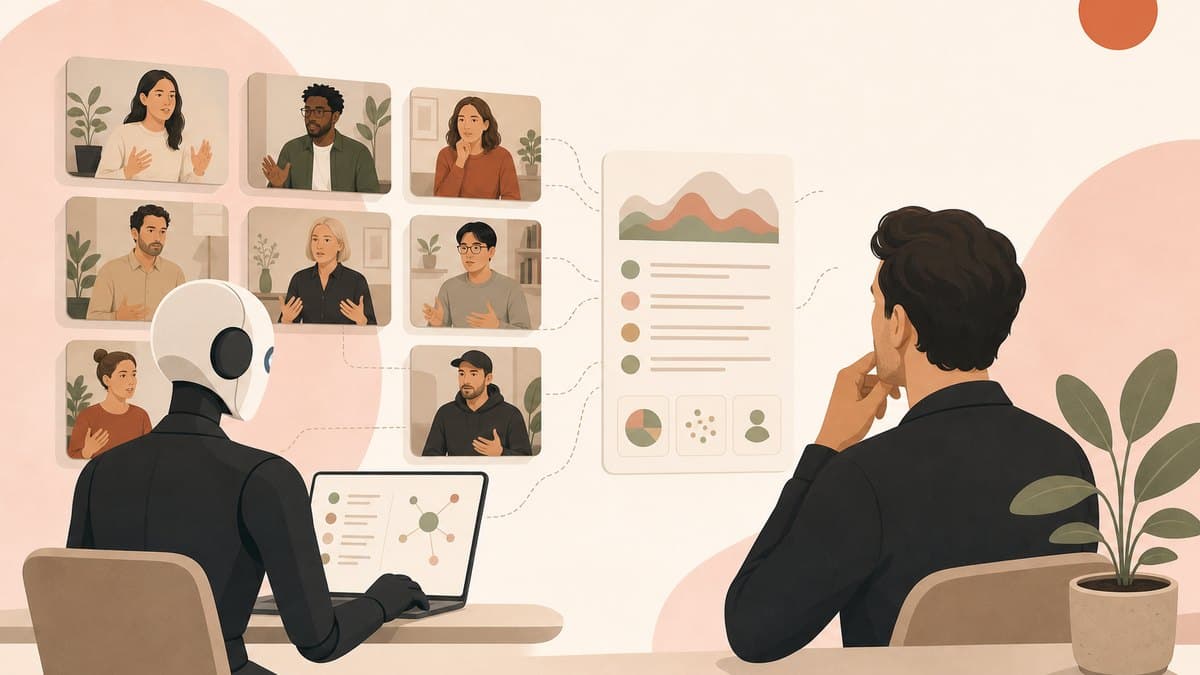
Table of contents
- What AI market research actually is
- Why surveys mislead and interviews do not
- Finding the right people is 80 percent of the work
- Speed and cost change what you can research
- Simulation: predicting answers before you ask
- What this means for how you build
- What to do this week
- Sources
- Frequently asked questions
Most founders learn what customers want the slow way. You ship something, watch a metric sag, guess at why, and maybe run a survey that a handful of people click through on autopilot. By the time an answer arrives, the decision is already made. AI market research flips that order. Instead of one study a quarter, you can run hundreds of real interviews and get usable answers back the same afternoon.
In a Sequoia Capital interview, Alfred Wahlforss, co-founder and CEO of Listen Labs, walks through how this works in practice. Listen Labs is an AI-first customer research platform that runs thousands of voice interviews at once. The company raised $27 million from Sequoia and, per Forbes, is valued around $500 million. This article distills what founders can take from that conversation: what AI market research actually is, where it beats the old playbook, and how to use it without fooling yourself.
What AI market research actually is
AI market research uses an AI agent to interview real people at scale, then synthesizes the answers into decisions you can act on. The mechanics are simpler than they sound. You ask a question like how do we improve our onboarding. The system writes an interview guide, which is the set of instructions the agent follows. Then it goes and talks to people, runs hundreds of those conversations, and hands back analysis and recommendations.
Wahlforss frames the goal plainly: "we have this AI agent that can understand your customers better than you can." The way it does that is by talking to them, one interview at a time, at a volume no human research team could match. Listen Labs says it can reach a panel of 30 million participants, from an oncologist to a software engineer, and in the Sequoia interview the company is described as serving 20% of the Fortune 500, including Microsoft, Anthropic, Sweetgreen, and NBC.
For a founder, the number that changes behavior is time. "You can get input within five minutes from real people," Wahlforss says. When a customer answer is minutes away instead of weeks, it stops being a special project and starts sitting inside ordinary decisions, the same way you would check analytics before shipping a change.
Why surveys mislead and interviews do not
One of the Sequoia partners pushes on the obvious objection: they have always been skeptical of surveys, because what people say they will do rarely matches what they actually do. Wahlforss does not dodge it. His team went back to the same person and asked the same multiple-choice question again, and the answers came back radically inconsistent. A survey captures a click, not a reason, and the click is noisy.
An interview forces something different. When a person has to reason through an open answer out loud, they are more consistent, and you get the why behind the click. It also sidesteps the questions surveys are worst at. As Wahlforss puts it, "You can't just ask like how much are you willing to pay for this" and expect a useful number back.
The AI interview adds signal a form cannot. It runs like a video call, so the agent can read tone and reaction, not just words. "So it looks at your eyes the way you say it," Wahlforss says, which brings the answer closer to real behavior. Listen Labs has seen this show up downstream: an ad that people react to enthusiastically on camera tends to perform better in paid channels than one that merely scores well on a survey scale.
There is a counterintuitive part too. People are often more candid with the machine. "We've also found that people are more honest talking to an AI," Wahlforss says. "It's a very therapeutic experience because it's a non-judgmental entity that's really interested in you." That opens up sensitive research, like understanding how kids react to a product, that is hard to run any other way.
None of this replaces hard telemetry. Wahlforss agrees an A/B test is the gold standard, but notes it needs a large volume of users to get right, and having some real input beats having none while you wait to reach that scale.
Finding the right people is 80 percent of the work
The part founders underrate is not the interview. It is who gets interviewed. "And that's actually where we spend 80% of our engineering resources," Wahlforss says about the audience. The insight only matters if you talk to the people whose opinion predicts the market.
He uses Sweetgreen as the example. You might assume a salad chain is for everyone, but the audience that matters is narrow: "the right audience is typically urban, high household income, mostly female," and, he adds, "they need to know what seed oils are, which only like 1% of the population does." Find the segment that eats there every day and drives most of the revenue, and the research gets far more actionable. Miss it, and you are averaging away the signal.
This is the same discipline behind writing an ideal customer profile: the leverage comes from being specific about which customers you are betting on, not from surveying the general population. AI market research is how you go find and talk to that segment at scale, including prospective customers you do not have a relationship with yet, which is exactly the group a customer list cannot reach.
Reaching the right people is also where the old approach broke down. Traditional panels lean on email lists with heavy screening, where the incidence rate can be brutal. "Only one in 10 people gets qualified to even take the interview," Wahlforss says, which burns out the panel and biases who is left. Building a large, profiled audience and searching it for the exact person is the part that was not possible before.
Speed and cost change what you can research
The friction of talking to customers is why most decisions get made without them. Lower that friction and two things happen. The cost per answer drops, because asynchronous AI interviews are cheaper to run than scheduling live sessions, and the volume of research you can afford goes up by orders of magnitude.
That does not mean research gets cheap across the board. Wahlforss says Listen Labs has been able to "charge hundreds of thousands of dollars to speak to 20 doctors across eight countries," because access to the right hard-to-reach people is what carries the value. The individual interview gets more affordable over time, but founders end up doing far more research, not less.
The speed also opens use cases that were previously off the table. Busy, high-value people like doctors will not schedule a focus group, but they will answer a few questions from their phone between patients. That reachability is the unlock, and it is why so many products that never talked to their users now can.
One caution matters here. When an AI hands you a tidy summary of hundreds of conversations, it is easy to trust a pattern that is not really there. The guardrail is traceability. "We built the platform around traceability so that for every data point you can always click and then look at the video or see the quote," Wahlforss says, so you can confirm the AI is not hallucinating where a conclusion came from. If you adopt AI market research, insist on that click-through to the raw source, the same way you would want clean, trustworthy data behind any AI feature.
Simulation: predicting answers before you ask
The frontier Listen Labs is building toward is simulation: after enough interviews, predicting how a customer would answer a question you have not asked yet. Interview one person for an hour and the model starts to predict their preferences. "In some cases we're able to get 95% accuracy to predict how they will answer certain questions," Wahlforss says.
The fuel for this is volume. "We've done a million interviews so far," he says, and that number is growing fast. Those interviews let the platform build profiles it can back-test, holding out a question to see whether the model would have predicted the real answer, and even checking that it knows when it cannot predict something.
The practical payoff shows up in small, frequent decisions. Wahlforss describes writing a hundred possible titles for a conference talk and running them through a simulated panel of his customer base. The top pick scored about twice as high as the next one. Run the same test against a general chatbot and it can pick the wrong option, because a general model is trained on the average person, not on your niche. Interestingly, his team found interviews make better fuel for this than behavioral data like credit card spend, because a good interview lets you probe the why behind a choice.
Simulation has a ceiling, and Wahlforss is candid about it. Even with near-perfect AI, people stay irrational and chaotic, latching onto a new trend overnight in ways no model predicts. So for the big, expensive calls, like a Super Bowl ad, you still run real interviews. Simulation is for the long tail of smaller questions where talking to real people was never worth the time. Treat it as guidance, not proof.
Simulated respondents are a category of their own, sold separately from interview platforms. Synthetic users are the other side of this coin, with their own grounding requirements, accuracy benchmarks, and a specific test for which questions a simulation can answer at all.
What this means for how you build
Step back and there is a loop here that every company runs: figure out what to build, build it, repeat. AI has made the build half faster and cheaper. The bottleneck is the other half, knowing what to build, and that is the half customer research addresses.
The most interesting version connects research directly to execution. Wahlforss describes customers wiring a churn interview to a coding agent: a user reports a bug in an interview, and that finding gets handed to an agent that opens a fix. Listen Labs now ships an integration so you can call your customers' preferences from inside tools like Claude and have an agent run research in a loop while it works. The line between learning what to build and building it gets thinner.
This is why market research sits upstream of product work. Deciding what to build as a product team depends on a steady supply of real customer signal, and AI research is how you keep that supply flowing instead of relying on a quarterly study. The companies that have always done this well, like Procter and Gamble, are marketing organizations that hunt for a specific unmet need and then build a brand around it. Tide Pods came from noticing people found liquid detergent uncomfortable to use and wanting something easier. The tools are new; the discipline of listening first is not.
What to do this week
- Write down the one decision you are about to make on a hunch, like an onboarding change, a pricing move, or a landing-page headline, and turn it into a single research question.
- Define the narrow segment whose opinion actually predicts your market before you recruit anyone. If your answer is everyone, you have not found it yet.
- Run a small batch of AI interviews, or even a handful of manual ones, against that segment this week rather than waiting for a big study.
- Demand traceability from any tool you try. If you cannot click from a conclusion to the raw quote or clip, do not trust the summary.
- Feed one finding straight into the build. Hand a real customer complaint to your team or a coding agent and close the loop.
AI market research is not a faster survey. It is a way to put real customer input inside everyday decisions, which changes what you build, who you build it for, and what you say about it. That is one piece of running an AI-first company, which is the larger subject of the AI for startups founder guide and the operating system this course teaches, AI Operating System for Startups.
Sources
- Knowing What Your Customers Want, All the Time: Listen Labs' Alfred Wahlforss (Sequoia Capital), the interview this article distills, on AI-run interviews, audience, simulation, and traceability.
- This $500 Million AI Startup Runs Customer Interviews For Microsoft And Sweetgreen (Forbes), for the funding, valuation, and client details.
- Alfred Wahlforss on LinkedIn and Listen Labs, for the founders (Wahlforss and co-founder Florian Juengermann) and company background.
- Cross-source context from Y Combinator's Cursor for Product Managers, on feeding customer interviews and usage data into what to build next.
Frequently asked questions
What is AI market research?
AI market research uses an AI agent to interview real people at scale and then synthesize their answers into decisions a team can act on. Instead of a human researcher running a handful of calls or sending a survey, the system writes an interview guide from your question, conducts hundreds of voice interviews in parallel, and returns analysis and recommendations. In a Sequoia interview, Listen Labs founder Alfred Wahlforss describes running these interviews across a panel of tens of millions of participants and getting input back within minutes rather than weeks. The point is to lower the friction of talking to customers so more decisions get made with real customer input instead of guesses.
Is AI market research accurate, and can you trust the results?
It can be accurate if the tool lets you trace every conclusion back to a source. The risk with any AI summary is that it hides how it got there, so the serious platforms are built around traceability: for each data point you can click through to the actual interview clip or the exact quote, which is how you check that the model is not inventing a pattern. AI interviews also add signal a survey cannot capture, like tone and facial reaction on video, which brings answers closer to how people actually behave. The honest limit is prediction: simulating how customers will answer future questions works for some cases and not others, so treat it as guidance, not proof.
How is AI market research different from surveys?
A multiple-choice survey captures a click, not a reason, and people answer inconsistently: when Listen Labs went back to the same person with the same multiple-choice question, the answers came back radically inconsistent. An AI interview makes the person reason through an open answer out loud, which tends to be more consistent and far richer. It also runs at a scale surveys and focus groups cannot match, hundreds of conversations at once instead of a few dozen, and it can reach prospective customers you do not already have a relationship with. The trade is that interviews were historically slow and expensive to run and analyze, which is exactly the cost AI collapses.
How do startups use AI for market research?
Founders use it to answer three different questions: what to build, who to serve, and what to say. On what to build, teams feed interview findings into product decisions and even wire a churn interview to a coding agent so a reported bug becomes a fix. On who to serve, they find the narrow high-value segment that drives most of the revenue before building for it. On what to say, they test taglines, ad concepts, and messaging against a modeled version of their audience. The common thread is speed: getting real customer input in minutes means it can sit inside everyday decisions instead of a once-a-quarter study.
Build your AI Operating System
A practical course to grow with AI, build internal tools, and operate safely. Join the waitlist and you'll be first in when the course opens.