AI Note Taker: What Founders Should Record

Cicero Campelo, CISSP
August 14, 2026 · 16 min read
Part of our guide to AI for startups.
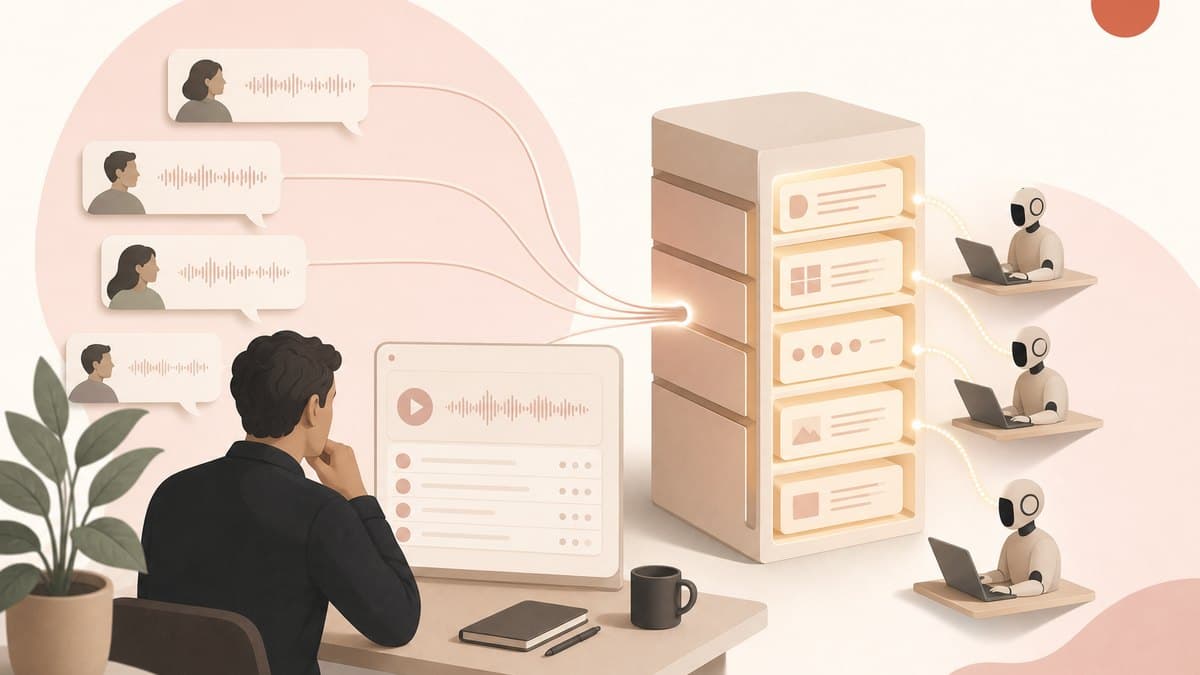
Table of contents
- What an AI note taker actually does
- Why the cost of not recording keeps rising
- Judge an AI note taker on what it leaves out
- Notes are worthless if you cannot query them later
- What to never let an AI note taker do
- Consent is the part founders skip
- How to evaluate an AI note taker
- What the same shift does to your calendar
- What to do this week
- Sources
- Frequently asked questions
An AI note taker records your meetings, transcribes them, writes the notes, and assigns the action items. By that description it is a convenience, something that saves you from typing while someone else talks, and that is how most founders buy one.
That framing is already out of date. The reason to run an AI note taker in 2026 has less to do with your notes and more to do with what your AI agents can see. Every agent you deploy works from context, and most of a startup's real context is spoken out loud in a meeting and then lost.
Ali Haghani is the co-founder and CEO of Circleback, a Y Combinator Winter 2024 company that raised a $2.5 million seed round in November 2024. He sells an AI note taker, so read him the way you would read any vendor: the useful part is the operating rules he draws, not the promise he makes. Sitting down with Y Combinator, he draws several, and the sharpest ones are about what he will not let his own software do.
What an AI note taker actually does
An AI note taker is software that joins or listens to a conversation, produces a transcript, writes structured notes from it, and extracts the follow-ups as assigned action items. The better ones add two things on top: automations that push what was said into the systems you already run, and retrieval, so you can ask questions across every conversation your team has had.
Haghani describes his own product in that order. It "records and transcribes your meetings, writes the notes, and assigns the action items." Then the part that matters more: it lets you build automations "to pull custom info from those meetings and update other apps that you use like your CRM, your issue tracker, your Slack." And finally, in his words, you "ask it questions across all of your team's conversations, connect your agents to it, and essentially use it as your company brain that remembers everything."
Those are four different products sold under one label, and they are worth separating before you buy:
- Transcription. Speech to text. Commodity, and has been for a while.
- Notes. A written summary a human would actually read. This is where quality varies most.
- Action items. Extraction of who owes what. Precision matters more than recall here, for reasons below.
- Retrieval and automation. Querying across meetings, and writing the result into other systems.
Most founders evaluate an AI note taker on the first two and then discover they bought it for the last two.
Why the cost of not recording keeps rising
Haghani's thesis is not that recording is nice. It is that not recording is becoming expensive, and the bill grows every quarter.
His reasoning is about agents rather than about people. As AI agents do more work inside a company, the context of what is going on becomes the constraint on how useful they are, because otherwise, he says, "your AI agent is working in isolation. It doesn't know what was said earlier today or what a customer said." His conclusion: "the opportunity cost of not recording is already pretty high and it's only going to become higher and higher." He expects more and more companies to "default to recording everything and default to sharing the context from conversations that can be shared across the company."
He is not alone on this, and the strongest version of the argument does not come from someone selling note-taking software. In a Y Combinator Root Access talk, YC general partner Tom Blomfield told a batch of founders that he would "make the entire organization legible to AI," and drew the line bluntly: if it is recorded, "it happened to the AI." If it was not recorded, as far as your intelligence layer is concerned it did not happen. YC now records partner emails, Slack messages, and office hours, and used roughly 2,000 hours of recorded office hours to regenerate its founder user manual over a single weekend.
The same point turns up as a structural advantage in another Root Access talk on context. Skyvern's co-founder, who says the company scaled past a $2 million run rate while he personally covered product, marketing, sales, and support with a stack of agents, argues that remote companies get this for free: in a remote company the context is on a call or in a Slack message, and in person it is lost. His summary is the sentence to put on the wall. Your tools are your company's knowledge base, and "anything you don't record isn't saved."
Y Combinator's own request for startups on the AI operating system for companies describes what the top of that curve looks like: the best AI-native companies "have figured out something most haven't. They've made their entire company queryable. Every meeting recorded, every ticket tracked, every customer interaction captured, all legible to an AI layer that learns from it."
If you run an in-person or hybrid startup, this is the part to sit with. Your hallway is an advantage for speed and a liability for memory. An AI note taker is the cheapest way to close that gap, and it is why the category is being repriced from a note-taking tool to the capture layer under everything else you are building. Where those captured notes go next is a separate build, and it is the one covered in AI knowledge management.
Judge an AI note taker on what it leaves out
Here is the counterintuitive part, and the most useful thing in the interview for anyone evaluating tools.
The failure mode of AI notes is not missing information. It is including everything. A summary that faithfully reproduces the meeting is a second meeting, and nobody reads it.
Circleback runs evals on exactly that boundary. Haghani's example: if someone says during a meeting that they are sending something right now, and there is signal in the conversation that the thing was actually done, that should not become an action item. It is already handled. Listing it is noise dressed up as diligence.
The house rule on writing style is even more specific. "We really try to never have our notes say the word discussed cuz it's fully pointless. Obviously, things were discussed. It's a meeting. It doesn't add any value."
That is a small rule with a big implication for how you should test a note taker. Run it on a real meeting with three or four decisions and a dozen tangents, then count the lines you would delete. The tool that produces twelve accurate bullets you skim is worse than the tool that produces four you act on.
Behind that sits an engineering point every AI founder should steal. Circleback keeps evals in place for anything quantifiable so it can tell whether a model swap or a prompt change made things better, "because if you don't have good systems in place to make incremental improvements, you're constantly playing this game of whack-a-mole" where the overview gets better and the topics get too long. If you are building anything on top of a model, that discipline is the whole job, and it is worked through in detail in LLM evals for founders.
Notes are worthless if you cannot query them later
The reason to record more is not to have more notes. It is to be able to ask questions later that you did not know you would need to ask.
Haghani's own uses are the clearest illustration, and none of them are note taking:
- As an applicant tracking system. He keeps a view of every open action item that belongs to someone at Circleback and came from an interview, so he can see who owes a candidate a reply and who is interviewing whom.
- As a relationship timeline. For a candidate he is excited about, he pulls a full timeline of every touchpoint that person has had with the team, emails and meetings both, plus how the last interview went and whether the next one is booked.
- As an account view. For a company his team talks to, he can see everyone they have spoken with there, what is outstanding, and what is coming up.
- As meeting prep. The night before the interview, he asked the tool to prepare him for it. It read the emails they had exchanged, their past conversations, and his calendar, and produced a brief.
- As a searchable archive. From a customer fireside chat earlier in the year, he can ask what a specific person's wish list was, get a rundown from a 30-minute call, then jump to that moment in the recording.
Notice that every one of those is a retrieval problem, not a transcription problem. That is the buying criterion most people skip.
It also has a hard limit worth stating up front. Blomfield made it in the same talk: you cannot pump 100,000 hours of recordings into a context window. Capture is step one, and synthesis is step two, and a pile of raw transcripts handed to an agent is a fast way to make its answers worse rather than better. That failure has a name and a fix, both covered in context rot.
What to never let an AI note taker do
This is where the vendor gets more interesting than the pitch. Asked what he does not let agents do, Haghani has a short list, and it is a good default policy for any startup wiring agents into its operations.
Never send an email on its own. "A draft is okay," he says, but the send stays human. The asymmetry is obvious once you say it out loud: a bad draft costs you 30 seconds, and a bad send costs you a customer.
Nothing that goes into production copy. An agent can take a first pass at product copy. He wants that copy to be super clear, so shipping it stays a human decision.
Nothing with data access and security. Agents are good at reviewing this class of work, and Circleback runs a sub-agent that does a review pass on that class of work. Being the reviewer is not the same as being the author.
No architecture. His framing: they do not want the agent to architect the thing. The engineer designs it, and the agent builds it out.
The through line is that agents get the reversible work and humans keep the irreversible work. That is the right instinct, and it happens to match how a security person would draw the same line, since the question is never how competent the system is on average but how bad the worst plausible mistake is and whether anyone would catch it.
Apply it to the note taker itself. A tool that records everything and can write into your CRM, your issue tracker, and your Slack is, in security terms, a system with broad read access and write access to your systems of record. Treat it like one. Scope its write permissions to the systems where a wrong entry is cheap to undo, and keep the ones where it is not behind a human. If you are weighing how much of this stack to run yourself, the self-hosted AI agent tradeoff is the same decision in a different setting.
Consent is the part founders skip
Record-everything advice usually arrives with the legal and human questions waved away. They are the questions that decide whether the rollout survives contact with your team.
Start with the law, because it is not uniform. In the United States, most states allow a conversation to be recorded with the consent of one party, while roughly a dozen require every party to agree, and the rules differ again for phone calls versus in-person conversations. The Reporters Committee for Freedom of the Press maintains a state-by-state recording guide that covers both, including the handful of states that treat a phone call differently from a conversation in a room. In the EU, a recording is personal data, so it needs a lawful basis, notice, purpose limitation, and a way for people to exercise their rights over it. None of this is exotic, and all of it is cheaper to handle in week one than in month nine.
Then the human question, which is the harder one. In the Root Access talk on context, Skyvern's co-founder says even his one-on-ones with his co-founder are recorded, and then says plainly that whether they should be is an open question. He is right to flag it. A one-on-one where someone tells you they are struggling is not the same artifact as a customer call, and a team that suspects the second kind of conversation is being fed to a company-wide search will stop having the first kind.
Haghani, whose commercial interest runs the other way, lands in the same place. The job is not only making capture easy but "giving our customers confidence that the things that are captured will be shared with the right people," with nothing shared inadvertently, so that someone can use the product for every conversation without wondering whether something said in a one-on-one reaches the whole company.
That is an access-control requirement, and it is the one to test before you roll anything out:
- Who can see a given meeting by default, and is the default the narrowest option or the widest one?
- Can a participant mark a conversation as private or delete it, and does that propagate to the derived notes and the search index?
- Is there a per-meeting way to not record, and does using it carry any social cost?
- How long is audio retained versus text, and can you set that per meeting type?
- What is the answer when a customer asks whether your vendor trains on their conversation?
Announce the policy before you turn recording on, name the meeting types that are never recorded, and put one person in charge of the answer. A recording culture that people trust is worth more than a complete archive that they route around.
How to evaluate an AI note taker
Buying criteria, in the order that predicts regret:
- Omission quality. Run it on one real, messy meeting. Count the lines you would delete. Fewer is better.
- Action-item precision. Does it list things already done during the call? That is the tell for whether anyone built evals behind it.
- Retrieval across meetings. Can you ask a question that spans six months of conversations with one account and get a usable answer with a jump back to the moment in the recording?
- Write access, scoped. Can it update your CRM or issue tracker, and can you limit which fields it may touch?
- Capture surface. Can you start a recording without opening a laptop, from a phone button or a watch, and can you import a recording made somewhere else? Haghani maps a phone button to start a capture and uses it multiple times a day.
- Permissions and retention. Everything in the section above.
- Agent access. Can your own agents read from it through an API, or is it a closed archive with a search box?
Criterion 7 is the one that separates a note-taking tool from the capture layer of an AI-native company, and it is the reason this purchase is worth more thought than its price suggests. The wider architecture it plugs into is laid out in the AI for startups pillar.
What the same shift does to your calendar
One more thing worth taking from the interview, since it is the reason founders adopt this stuff and then quietly stop using half of it.
Haghani says he is doing much less of the founder work he disliked, the operations tasks he disliked, like logging into the payroll software to do something himself, because he automated them. His words for the result: he is "not constantly underwater from all the miscellaneous things that surround running a company." He also protects Thursdays as a no-meeting day and tries to ship something end to end within it.
That is the pattern to copy. Recording more meetings is only worth it if the recording buys back time somewhere else. If your note taker produces a beautiful archive and your week looks identical, you bought a filing cabinet.
What to do this week
- Pick one meeting type to record end to end, ideally customer calls, and leave one-on-ones out of the pilot.
- Write the consent line you will say at the top of the call, and check your state or country rule against the guides linked above before you say it.
- Run two AI note takers on the same three meetings, and score them on lines you would delete and action items that were already done.
- Name the default sharing scope before anyone else joins the pilot, and set it to the narrowest option that is still useful.
- Wire exactly one automation, the lowest-stakes one you have, such as pushing action items into your issue tracker. Leave sending anything to a customer as a draft.
- At the end of the week, ask your archive a question you could not have answered before, like what three customers said about the same feature. If it cannot answer, the problem is retrieval, not capture.
- Put one person in charge of retention and access rules, and give them the authority to say no.
The pattern behind all of this, capture the context, keep humans on the irreversible steps, and build the systems that make each week cheaper than the last, is what the course teaches end to end: AI Operating System for Startups.
Sources
- Circleback CEO Ali Haghani: Why Your Company Should Be Recording More Meetings, Y Combinator. The interview this article distills: the recording thesis, the evals, the agent guardrails, and the retrieval workflows.
- How to Build a Self-Improving Company with AI, YC Root Access. Tom Blomfield on making an organization legible to AI, and on why raw recordings still have to be synthesized.
- How to Give AI Agents Enough Context to Be Useful, YC Root Access. Skyvern's co-founder on recorded context as a remote-company advantage, and on recording internal calls.
- The AI Operating System for Companies, Y Combinator. The request for startups describing companies that made themselves queryable.
- Circleback background: the company's own seed funding announcement and TechCrunch's coverage of the launch. Profiles: Ali Haghani and Tom Blomfield.
- Recording law: the Reporters Committee for Freedom of the Press Reporter's Recording Guide, which covers the one-party and all-party states and the phone versus in-person distinction.
Frequently asked questions
What is an AI note taker?
An AI note taker is software that joins or listens to a conversation, transcribes it, writes structured notes from it, and extracts the follow-ups as assigned action items. The better tools add two capabilities on top: automations that push what was said into the systems you already run, such as a CRM or an issue tracker, and retrieval, so you can ask questions across every conversation your team has had rather than reading one meeting at a time. Those last two are what separate a note-taking tool from a capture layer your AI agents can read from.
Should a startup record every meeting?
Record more than you do today, and start with customer calls rather than one-on-ones. Ali Haghani, co-founder and CEO of Circleback, argues that as AI agents do more work at a company the opportunity cost of not recording is already pretty high and is only going to get higher, because an agent without context is working in isolation. Y Combinator general partner Tom Blomfield makes the same point from the other side: if something is recorded it happened as far as your AI layer is concerned, and if it was not, it did not. The caveat is that sensitive conversations need a different default, since a team that suspects one-on-ones are searchable company-wide will stop being candid in them.
Is it legal to record meetings with an AI note taker?
It depends on where the participants are, so check before you turn it on. In the United States most states allow a conversation to be recorded with the consent of one party, while roughly a dozen require every party to agree, and the rules differ again between phone calls and in-person conversations. The Reporters Committee for Freedom of the Press maintains a current state-by-state guide. In the EU a recording is personal data, so it needs a lawful basis, clear notice, purpose limitation, and a way for people to exercise their rights over it. Practically, say a consent line at the top of the call and name the meeting types you never record.
What should you never let an AI note taker do?
Keep the irreversible actions human. Ali Haghani, co-founder and CEO of Circleback, does not let agents send an email on their own, since a draft is fine but the send stays with a person. He also keeps agents out of production copy, out of anything involving data access and security beyond a review pass, and out of architecture decisions, where the engineer designs and the agent builds. Apply the same rule to the note taker itself: it is a system with broad read access and write access to your systems of record, so scope its write permissions to places where a wrong entry is cheap to undo.
Build your AI Operating System
A practical course to grow with AI, build internal tools, and operate safely. Join the waitlist and you'll be first in when the course opens.