The Future of Software Engineering Is I-Shaped

Cicero Campelo, CISSP
July 7, 2026 · 8 min read
Part of our guide to AI for startups.
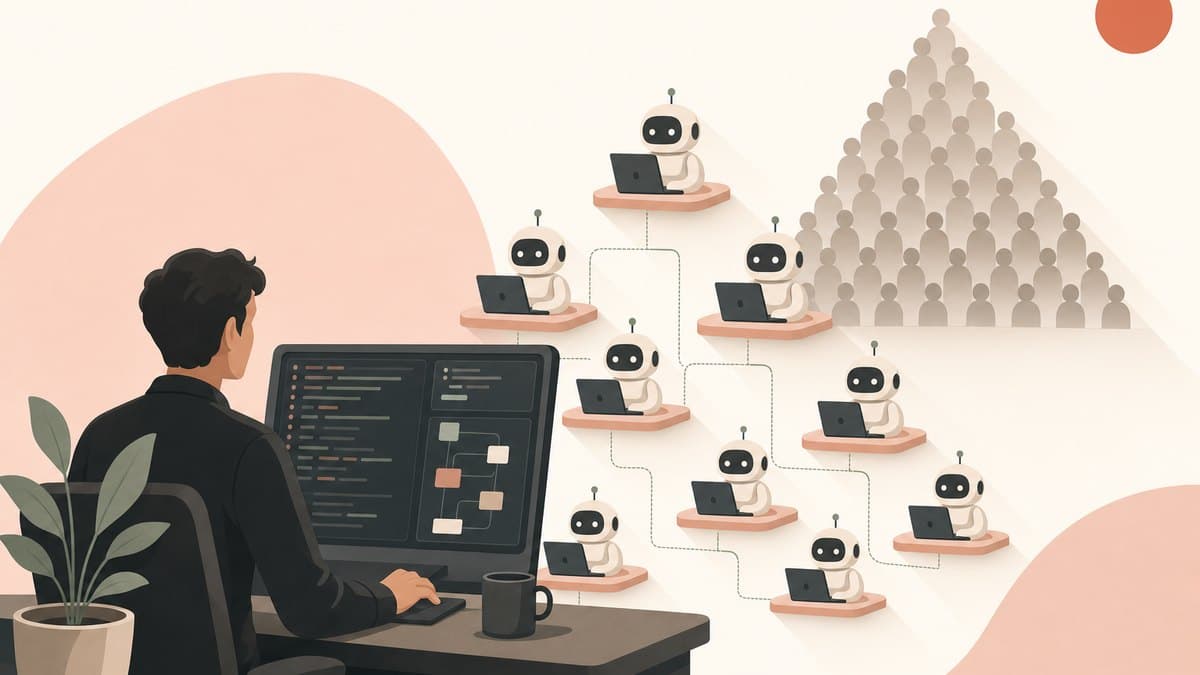
Table of contents
- Why the pyramid existed in the first place
- AI is automating the base of the pyramid
- What replaces it: the I-shaped team
- The electric motor lesson: do not just bolt AI onto the pyramid
- It is easier to build the new team than to retrofit the old one
- What the surviving engineering role looks like
- What to do this week
- Sources
- Frequently asked questions
For about thirty years the software team looked like a pyramid. A manager at the top, a few senior engineers under them, and a wide base of junior engineers writing most of the code and fixing most of the bugs. That shape is starting to collapse. In a Y Combinator Root Access conversation titled "AI Agents Are Killing the Engineering Pyramid," the argument was direct: AI coding agents now handle a large share of the work the base of the pyramid used to do, so the base is shrinking. The future of software engineering is not a bigger pyramid. It is a smaller, flatter team of people who know both what to build and how to build it. Here is what that shift means, and what founders should do about it.
Why the pyramid existed in the first place
The pyramid was never a law of nature. It was a staffing answer to a throughput problem. Building and maintaining software took a lot of hands, so the org chart grew to match: senior engineers designed the systems and made the hard calls, and a large base of junior engineers implemented the pieces, wrote the tests, and cleared the bug queue. More features meant more people, and the pyramid was how you scaled that up without every decision routing through one overloaded architect.
That structure carried a cost that everyone accepted because there was no alternative. Coordination overhead grew with headcount. Knowledge got split across layers, so the person who decided what to build often was not the person who built it, and the person who built it often did not fully understand why. It worked because the base did real, necessary labor. Remove the reason the base exists, and the shape has no reason to hold.
AI is automating the base of the pyramid
That is exactly what is happening. AI coding agents automate a large amount of the coding and design work that used to require a team, which reduces the need for a wide base of engineers doing routine implementation. The tasks most exposed are the well-documented, repeatable ones: scaffold this endpoint, write these tests, fix this class of bug. Those are the tasks a model has effectively seen many times, and they were a big part of what the base of the pyramid did all day.
This is not one show's hot take. Across the founder and investor conversations we track, the same read keeps surfacing. On a16z, Benedict Evans has said the future of junior engineering roles is genuinely uncertain precisely because the tasks traditionally handed to junior engineers are the ones getting automated. On Y Combinator's own channel, founders describe their engineers shifting from narrow specialists toward generalists who own more of the stack. The routine base is being absorbed. The judgment on top is not.
The point is not that engineering is going away. Demand for people who can direct AI to build the right thing is rising. What is going away is the assumption that shipping more software requires proportionally more engineers.
What replaces it: the I-shaped team
The conversation's answer to "what replaces the pyramid" is a shape: the team is becoming I-shaped. Fewer people, but each one deeper, able to understand both what needs to be built and how to build it, and to carry a piece of work from idea to production.
It helps to compare it to the shapes people already use. A generalist is sometimes called T-shaped: broad across many areas, deep in one. The I-shaped builder the AI era rewards goes deep on both ends of the stick, the product judgment and the implementation, because AI collapses the distance between deciding what to build and building it. When an agent can implement a well-specified idea in an afternoon, the bottleneck is no longer typing. It is knowing what to type and being able to tell whether what came back is right.
You can see the same instinct in how AI-native teams hire and organize. Andrej Karpathy, describing how to hire for this kind of work on Sequoia's channel, suggests giving a candidate a real project to implement rather than a puzzle to solve, because the job is now end-to-end building, not narrow problem-solving. And YC founders building companies from the ground up with AI describe a world where everyone builds, not just the people with "engineer" in their title. Both point at the same thing: fewer, more capable builders who own outcomes instead of tickets.
The electric motor lesson: do not just bolt AI onto the pyramid
The most useful idea in the conversation is an analogy from economic history, and it is the part founders most often get wrong. When factories first got electricity, they simply swapped the giant central steam engine for one big electric motor and kept everything else the same: the same overhead shafts, belts, and pulleys driving every machine in the building. The result was a modest improvement and not much more.
The real gains came decades later, and only once manufacturers redesigned the factory around what electricity actually made possible. Small motors on each machine, laid out for the flow of work instead of the reach of a driveshaft. The economic historian Paul David documented this in his 1990 paper "The Dynamo and the Computer": electric motors were available from the 1880s, yet in 1899 they still supplied less than 5 percent of the mechanical drive in American factories, and the productivity surge did not arrive until the 1920s, once the process itself was rebuilt. Replacing the engine was necessary. It was nowhere near sufficient.
AI in engineering is at the same fork. Bolting coding agents onto an unchanged pyramid, one agent handed to each junior to do the same tasks a little faster, is the electric-motor-on-the-old-driveshaft move. You get an incremental bump and you miss the real gain. Even that incremental bump depends on running current tools rather than stale ones, since the gap between a frontier AI developer tool and a year-old one can be two to three times the productivity on its own. The real gain comes from redesigning the team around what agents make possible: fewer people, higher judgment, more work carried end to end, and process built for a world where implementation is cheap and verification is the constraint. The founders who win this are not the ones who add AI to the old structure. They are the ones who rethink the structure.
It is easier to build the new team than to retrofit the old one
This is the part that favors startups. The conversation makes a point that should be encouraging if you are small: it is a lot easier to create a new team, a new product line, or a new organization that is AI-native from day one than to convert a big existing machine. Incumbents have to unwind layers of process, roles, and habit that were built for the pyramid. A founder building now gets to design the team around agents from the first hire.
Being AI-native from the start changes how the team works, not just how big it is. Because agents move fast and run in parallel, a small team can run many experiments at once, most of them cheap, and let the few that work compound. The infrastructure is adapting to match: serverless databases like Neon, which Databricks acquired for about one billion dollars in 2025, are built to spin up and tear down instantly so each experiment costs almost nothing, and the majority of new databases on it are now created by AI agents rather than humans. The lesson for founders is not "buy this tool." It is that the whole stack, from team shape to infrastructure, is being rebuilt for small teams running agents at scale. Design for that.
What the surviving engineering role looks like
If the base shrinks, what is the work that remains, and grows? It moves up the stack. When an agent writes the code, reading and verifying that code becomes the bottleneck, so critical review turns into a core skill rather than a chore. System design, debugging by reasoning about behavior, and choosing what is worth building at all become the high-value work, because those are the parts a model cannot reliably supply on its own.
This is the same shift we described in the move from vibe coding to agentic engineering: the engineer stops being the person who types the implementation and becomes the person who specifies, directs, and verifies it. It is also why the panic about AI erasing careers misses the point. As we argued in our honest answer on whether AI will take your job, the work is being repriced, not deleted: the repetitive part gets cheap, and the judgment part gets more valuable. If the question you are really asking is the personal one, whether AI will replace you as a software engineer, the answer is the same: the role moves up to judgment rather than disappearing. The engineer who thrives is the one who climbs toward the judgment and lets the agents handle the rest.
What to do this week
- Map your own pyramid. Write down the work your team does, then mark which parts are routine, well-documented implementation a coding agent could take today. That list is your automation surface.
- Point agents at that routine base first, not at your hardest problems. Free your best people from the toil before you ask AI to do the judgment work it is not ready for.
- Make review a first-class job. If code is cheap to generate, verifying it is your new bottleneck, so budget real time for reading and testing what agents produce.
- Hire I-shaped, not narrow. For your next engineering hire, give a real end-to-end project as the test and look for someone who can own an outcome, not solve a puzzle.
- Redesign one workflow around agents instead of adding agents to it. Pick a single process and rebuild it for a small team running agents in parallel. That is the electric-motor rewire, not the bolt-on.
The future of software engineering is fewer, more capable people directing a lot of machine labor. Building the team and the operating model for that world is exactly what we teach founders in AI Operating System for Startups.
Sources
- AI Agents Are Killing the Engineering Pyramid, the Y Combinator Root Access conversation this article distills (the pyramid-to-I-shaped framing and the electric-motor analogy).
- On the electric-motor and productivity history: Paul David's 1990 paper "The Dynamo and the Computer" and the BBC's summary of why electricity took decades to change manufacturing.
- On Neon and lightweight infrastructure for AI agents: Databricks' announcement of the Neon acquisition and TechCrunch on the roughly one-billion-dollar deal.
- Cross-source on the changing engineering role: a16z with Benedict Evans, "The Economics of AI Usage" (the future of junior roles is uncertain as their tasks get automated), Y Combinator, "Coding Will Be Solved For Everybody" (engineers becoming generalists), Y Combinator, "How To Build A Company With AI From The Ground Up" (in an AI-native company, everyone builds), and Andrej Karpathy on Sequoia's channel (hire agentic engineers with a real project, not a puzzle).
Frequently asked questions
What is the future of software engineering?
The clearest trend is that the engineering team is getting smaller and flatter. For decades a software team looked like a pyramid: a manager, a few senior engineers, and a wide base of junior engineers writing most of the code and fixing most of the bugs. AI coding agents now do a large share of that base-level work, so teams are shrinking toward what a Y Combinator Root Access conversation calls an I-shaped structure: fewer but more skilled people who understand both what to build and how to build it. The role does not disappear, it moves up the stack toward judgment, architecture, and reviewing what the agents produce.
Will AI reduce how many software engineers a team needs?
It changes the mix more than it deletes the headcount. The most exposed work is the repetitive, well-documented coding and bug-fixing that used to fill a junior engineer's day, which is exactly what coding agents are good at, so a team needs fewer people doing only that. What grows more valuable is the work a model cannot do on its own: deciding what to build, designing the system, setting the standard, and verifying the output. On a16z, analyst Benedict Evans has said the future of the junior engineer role is genuinely uncertain because the tasks traditionally handed to juniors are the ones being automated. The work of directing AI to build the right thing is where the value moves. For the individual-career version of this question, see whether [AI will replace software engineers](/blog/will-ai-replace-software-engineers).
What is an I-shaped engineering team?
An I-shaped team is made of people who go deep on both the what and the how: they understand the product and the customer well enough to decide what should be built, and they can build it (or direct agents to build it) end to end. It contrasts with the old pyramid, where that knowledge was split across many layers, with juniors implementing what seniors specified. As AI absorbs the routine implementation, the split stops paying for itself, and small teams of full-stack, high-judgment builders outperform large layered ones.
What skills will software engineers need in the AI era?
The durable skills move up a level. Reviewing and verifying code becomes the bottleneck, so reading code critically matters more than typing it fast. System design, debugging by reasoning about behavior, and knowing what is worth building all grow in value. So does breadth: engineers are becoming generalists who own a feature from idea to production rather than specialists handed a narrow ticket. The most valuable move is getting fluent at directing a fleet of coding agents and checking their work, not competing with them on raw output.
Build your AI Operating System
A practical course to grow with AI, build internal tools, and operate safely. Join the waitlist and you'll be first in when the course opens.