AI Cold Calling: A Founder's Field Guide

Cicero Campelo, CISSP
July 1, 2026 · 8 min read
Part of our guide to AI for startups.
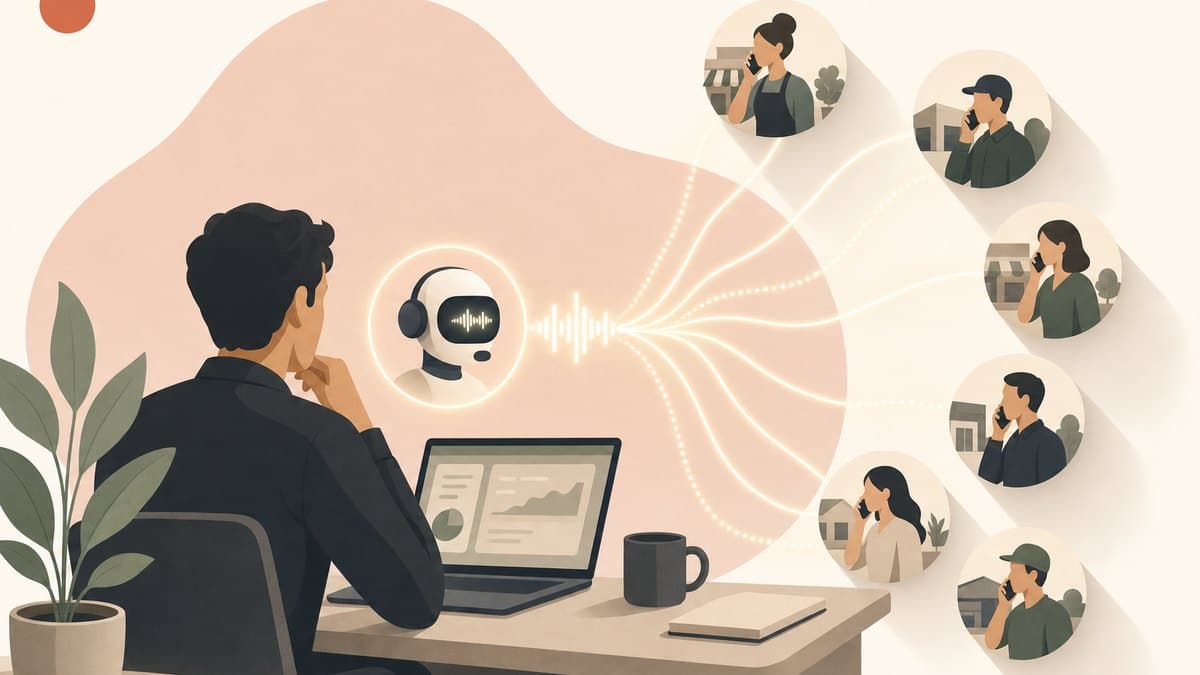
Table of contents
Cold calling is the sales job everyone hates and no one can fully replace. Now a wave of startups is trying to hand it to AI. The clearest example is Simple AI, a Y Combinator company whose tagline is literally "AI voice that sells." In a YC Root Access interview, its founders describe an AI that answers your phones, makes outbound calls, and, they claim, upsells about 30 percent better than a trained human rep. Here is what AI cold calling actually does today, where it still breaks, and how to pilot it without torching the trust you spend years building.
What "AI cold calling" actually means
AI cold calling is software that places or answers sales calls with a synthetic voice, holds a real conversation, and pushes toward an outcome, instead of a person dialing down a list. It runs in two directions. Outbound, where the AI calls prospects to qualify, book, or sell. And inbound, where it picks up and says something like "thank you for calling, how can I help you?" before handling the request. Simple AI's model is to sit in front of a business's existing phone system and take the calls it is allowed to take. That inbound side is a business in its own right in the trades, where the same voice-agent approach powers AI for field service companies that answer the phone and book jobs for home-services businesses.
The important distinction is that this is not a robocall or a touch-tone menu. It is a conversation. The AI pulls real-time product data, prices, and each caller's history, then adapts to what the person actually says. That is why voice is the interesting frontier here and not just another chatbot channel. As ElevenLabs co-founder Mati Staniszewski argued on Sequoia's podcast, voice is becoming the primary interface for AI, and voice agents in sales capture more information in a single call than a form ever could. A phone call is the highest-bandwidth channel most businesses have, and it is the one that was hardest to automate well until now.
The broader strategy behind that interface bet is in Mati Staniszewski's founder playbook.
How this got good, fast
Simple AI was founded in 2024 by Catheryn Li, the CEO, and Zach Kamran, the CTO, two engineers who spent roughly four years at Y Combinator building the firm's internal software, including Startup School, Bookface, and co-founder matching. They did not start in sales. The company began as a consumer app, an attempt to build the assistant Siri should have been, one that could call a business on your behalf. Then the pull came from users: people who had tried the app told the founders their voice feature was too good to keep to a consumer toy, and asked to use it for their own businesses. So they pivoted to sales.
That pivot is the founder lesson worth more than the technology. The team was not expert in phone sales, they followed what users pulled the product toward, which is the plainest version of YC's oldest advice: make something people want. The company went through YC's Summer 2024 batch and in early 2026 raised a 14 million dollar seed round led by First Harmonic, with Y Combinator, True Ventures, and Massive Tech Ventures also in. If you are weighing whether AI should power a product or be the product, this is the service-as-software pattern in a phone line: the AI does the selling, it is not a dashboard a rep uses to sell.
What the AI does that a rep cannot
Once the call connects, a few things separate the software from a person:
- It knows everything, instantly. Every SKU, price, promotion, and policy is in memory, so it never fumbles a question or puts you on hold to "check with someone."
- It remembers you. It can recall a caller's past orders and preferences and personalize the pitch, the way a great rep would if they had perfect recall of every customer.
- It A/B tests itself. Simple AI's founders describe running experiments on scripts across many calls, so a winning line, something as plain as an offer to lock in savings today, can be found and rolled out to every call at once. A human sales floor cannot iterate that fast.
- It scales without fatigue. It can hold many conversations at the same time, around the clock, and the thousandth call is as sharp as the first.
Stack those up and you get the company's headline claim, that the AI upsells roughly 30 percent better than a trained live rep. Read it as Simple AI's own number, because it is, but the mechanism behind it is real: perfect product knowledge plus fast experimentation is a genuine edge on the kind of call that follows a script.
Where AI cold calling still breaks
The demo always looks magical. That is exactly the trap. A polished 90-second demo hides the calls that go sideways, and on the phone the failures are expensive because a confused or robotic moment reads as a bad company, not a bad tool.
The bar is higher than most founders expect. Another YC company, Phonely, frames its goal as building voice that 80 percent of callers believe is human, which tells you how much polish it takes before an AI call stops feeling like a downgrade. Getting there in production, across phone trees, accents, interruptions, and angry customers, is hard engineering, and it is why deploying a voice agent into a real business, as the YC talks on Fortune 500 voice deployments make clear, is more integration work than magic.
Then there is the line you cannot cross. Cold calling is one of the most regulated things a startup can do, and pointing an AI at it does not lower the bar, it raises the stakes because the machine can dial faster than any human. As a CISSP, the part I would not hand to an eager growth plan is compliance. In the United States the TCPA governs telemarketing and calls made with an artificial or prerecorded voice, which generally means you need the right consent and must honor Do Not Call requests, and a growing set of state laws now require you to disclose that the caller is a bot. Build disclosure, consent capture, opt-out handling, and call logging in from day one, and run the script and the list past counsel. "The AI did it" is not a legal defense.
How to run a pilot without torching your brand
You do not have to choose between ignoring this and betting the brand on it. Run a contained pilot:
- Start warm, not cold. Point the AI at inbound calls or a list of customers who already know you, where it has context and the legal and reputational risk is lowest. Save true cold outbound for after you trust it.
- Pick one narrow call type. Choose something high-volume, script-able, and low on emotion: order status, a renewal, a simple upsell. Do not start with the call that needs a human's judgment.
- Write the escalation rule first. Decide, before the script, exactly when the AI hands off to a person. An AI that knows its limits beats one that improvises past them.
- Disclose, consent, log. Tell callers they are talking to AI, capture consent, record with notice, and keep every transcript.
- Grade against your best rep. Measure conversion or upsell against your top performer, not your average, and read the losing transcripts closely. The calls it quietly loses tell you more than the ones it wins.
For where phone outreach fits in your broader go-to-market, most bottom-up startups still start with cold calling to reach early users, and AI changes the cost of that outreach more than it changes the motion itself.
What to do this week
- List your call types by volume and pick the one that is most repetitive and least emotionally loaded. That is your pilot candidate.
- Write the escalation rule, when the AI hands the call to a human, before you write a single line of script.
- Check the legal basics: consent, Do Not Call, and whether any state you call into requires AI disclosure. Loop in counsel now, not after launch.
- Run a 20-call pilot on a warm list, record with notice, and grade the transcripts against your top rep.
- Decide the one metric that matters (conversion, upsell, or resolution) and instrument it before you scale anything.
AI cold calling is real, and on the right call type it already beats a human. It is also a fast way to annoy customers and invite a regulator if you skip the guardrails. Treat it like hiring a tireless junior rep: give it a narrow job, a clear escalation path, and a compliance leash. If you want the system for deciding where AI belongs across your company, not just on the phones, that is what we teach in the AI Operating System for Startups.
Sources
- This AI Startup Is Taking Over Phone Sales, the YC Root Access interview with Simple AI that this article distills.
- Simple AI: the Y Combinator company page and its founders, Catheryn Li (CEO) and Zach Kamran (CTO), both former YC engineers.
- The 14 million dollar seed round (First Harmonic, Y Combinator, True Ventures, Massive Tech Ventures): Simple AI's own announcement and Upstarts Media.
- Voice as the interface for AI: ElevenLabs co-founder Mati Staniszewski on Sequoia's podcast.
- The human-parity bar for voice: Phone AI on YC Root Access. Enterprise deployment reality: What It Actually Takes to Deploy a Voice Agent to a Fortune 500.
- US telemarketing rules referenced (TCPA, Do Not Call, artificial-voice consent) are general compliance context, not legal advice; confirm your specifics with counsel.
Frequently asked questions
What is AI cold calling?
AI cold calling is software that places or answers sales calls with a synthetic voice, holds a real back-and-forth conversation, and works toward an outcome, such as qualifying a lead, booking a demo, closing a sale, or upselling, instead of a human dialing down a list. It runs in two directions: outbound, where the AI calls prospects, and inbound, where it answers your phones and greets callers. It is different from a robocall or a phone menu because it is a conversation: the AI pulls real-time product data and customer history and adapts to what the person says.
Does AI cold calling work better than human sales reps?
The company behind Simple AI says its AI upsells about 30 percent better than a trained live rep, and voice AI does hold clear advantages: it knows every product detail in real time, never has a bad day, and can run thousands of calls at once. Treat the 30 percent as the vendor's own number and test it against your best rep, not your average one. In practice AI cold calling works best today on repetitive, script-able calls (order status, renewals, simple upsells) and still struggles with emotionally charged or complex conversations, so the honest answer is that it beats a human on some call types and not others.
Is AI cold calling legal?
It can be, but sales calls are heavily regulated and using AI does not lower the bar. In the United States the TCPA governs telemarketing and calls that use an artificial or prerecorded voice, which generally means you need the right consent and must honor Do Not Call requests. A growing set of state laws also require you to disclose that the caller is a bot or AI. The safe pattern is to disclose that the caller is AI, capture consent, honor opt-outs, record with notice, and run your script and call list past counsel before you scale. Do not let 'the AI did it' become your legal exposure.
How do I start using AI cold calling in my startup?
Start narrow. Pick one high-volume, script-able call type that carries little emotional weight, write the escalation rule that hands the call to a human the moment the AI is out of its depth, and run a small pilot on a warm list rather than a cold blast to strangers, since the AI performs best when it has context and the legal and reputational risk is lower. Disclose that the caller is AI, log every call, and grade the transcripts against your top rep. Only scale the call type once the numbers hold and you have instrumented the metric that actually matters to you.
Build your AI Operating System
A practical course to grow with AI, build internal tools, and operate safely. Join the waitlist and you'll be first in when the course opens.