AI for Field Service: The Founder Playbook

Cicero Campelo, CISSP
July 24, 2026 · 8 min read
Part of our guide to AI for startups.
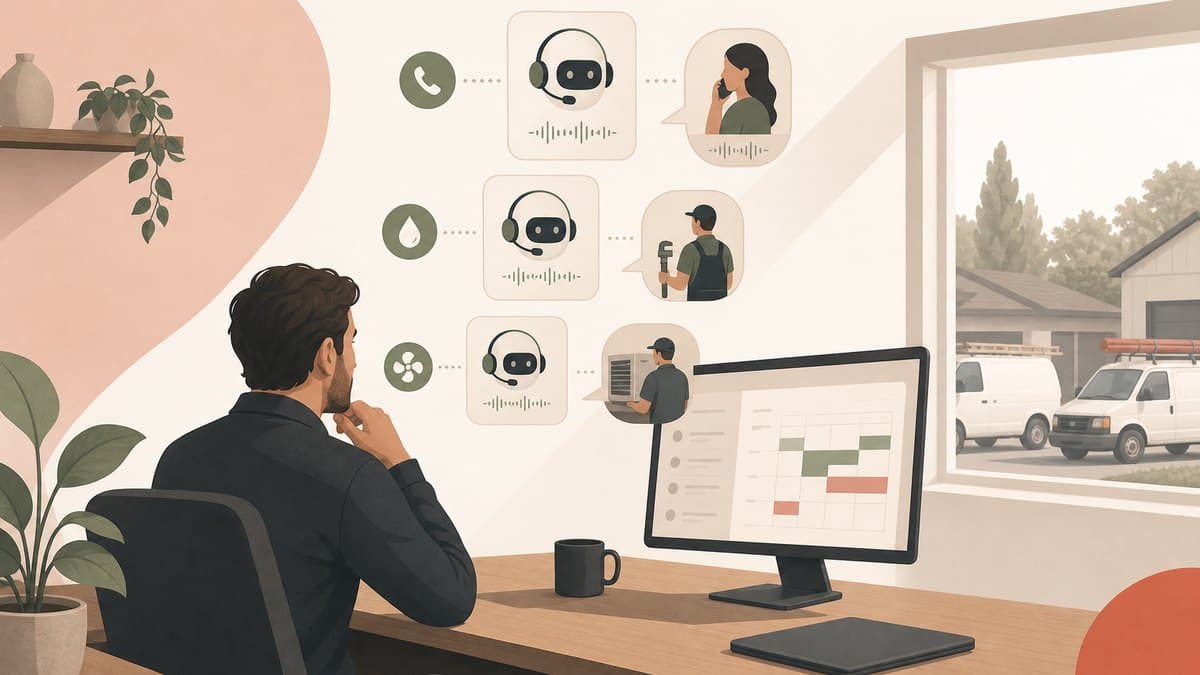
Table of contents
Field service is a phone business. When someone's air conditioning dies in July, they do not fill out a form and wait. They call three companies, and the first one that picks up and books the visit wins the work. Every company that lets the phone ring out just handed a paying customer to a competitor. In home services that missed call is not a small loss: it can be a multi-thousand-dollar job walking to whoever answered.
That single fact is why AI for field service has become one of the sharpest wedges in vertical AI. Avoca, a Y Combinator company that describes itself as the AI workforce for the physical economy, built an AI voice agent that answers the phone for home-services businesses, books the job, and follows up. It now serves more than 800 companies and raised over $125 million at a $1 billion valuation, according to Fortune. This piece explains what AI for field service actually does, why the phone is the whole game, and the founder playbook you can copy whether you sell into these businesses or run one.
What "AI for field service" actually means
Field service covers the trades that come to your home or business to fix something physical: HVAC, plumbing, electrical, roofing, pest control, garage doors. These are real companies with trucks, technicians, and a front desk that lives on the phone. For most of them the software stack is a scheduling and dispatch tool plus a lot of manual call handling.
AI for field service targets the call handling first. The core product is an AI voice agent, sometimes called an AI CSR because it does the work of a customer service representative, that answers inbound calls at any hour, understands what the caller needs, and books the appointment straight into the schedule. From there the same layer can chase old leads with outbound follow-up, send text confirmations and reminders, and route the harder calls to a human. The point is not a chatbot on a website. It is answering the phone, the channel these businesses actually run on, and turning a call into a booked job without a person having to be free at that moment.
This is a specific flavor of the broader shift we track across the AI for startups pillar: software that does the work instead of handing you a tool. It is the same idea behind service as software, applied to the least glamorous, most phone-heavy corner of the real economy.
Why the phone is the whole game
The reason field service is such a clean market for AI comes down to the value of one call. Avoca's founders started out building for restaurants and only found the real opportunity when a Dallas HVAC company, Rescue Air, found them at a Texas conference. Co-founder Tyson Chen put the difference plainly to Fortune: "When a restaurant misses a phone call, that's a $30, $40 order. When a home service business misses a phone call, that could be a $30,000, $40,000 HVAC install they're missing."
Sit with that gap. The same missed call is worth a thousand times more in one business than the other. And these are exactly the businesses that struggle to answer: the owner is on a roof, the front desk is slammed at 9am, nobody is staffing the line at 8pm when a pipe bursts. The result is a steady leak of high-value jobs, invisible because a call that never gets answered never shows up in any report. An AI agent that reliably picks up and books the visit pays for itself off a single captured install. That combination, extreme value per call and a channel the business cannot fully cover, is what makes the wedge work.
It is also why founders keep pointing voice AI at these markets. If you are exploring the same territory from the sales side, the tactics overlap with AI cold calling, where the phone is the product and the compliance line matters just as much.
The Avoca playbook founders can copy
You do not have to be building for the trades for the Avoca story to be useful. A few moves generalize to almost any vertical AI product.
- Follow the pain to the vertical, do not force it. Chen and co-founder Apurva Shrivastava, who met at MIT, built a general missed-call system for restaurants first. They pivoted only when they saw the economics of a home-services call in person. The lesson is not to simply copy them into home services. It is that the right wedge is usually the one where your product captures the most value per use, and you often find it by talking to a customer, not by planning.
- Write a painfully narrow customer profile. Avoca did not sell "AI for small business." It sold an AI CSR to home-services companies where a missed call is a lost install, the same discipline a founder needs to enter a market as broad as AI for supply chain or AI for manufacturing. Naming that specific customer is what let a voice agent become a must-have rather than a nice-to-have. This is the same discipline behind writing a narrow ideal customer profile before you chase broad demand.
- Win a few design partners completely before you scale. The early motion in these businesses is not a big launch. It is pouring into a handful of first customers, like Rescue Air, until the product genuinely books them jobs, then using that proof to earn the next ones. In tight-knit trade markets where owners talk to each other, a few delighted customers become a referral engine.
- Measure the outcome, not the activity. The metric that sells a field-service owner is jobs booked and revenue captured, not calls answered or minutes handled. Vertical AI wins when you can point at money the customer would otherwise have lost. Build your product and your pitch around that number.
Augment the team, do not just cut it
The instinct with a call-answering agent is to frame it as replacing the front desk. The more durable framing, and the one Avoca's founders use publicly, is augmentation. Speaking to HomePros News, Chen and Shrivastava put it this way: "Great CSRs are still incredibly valuable. But they can't answer every call, every night, every weekend, with no breaks and no missed volume. Avoca helps catch the demand the team can't get to and frees the best people up for the work humans are better at."
That is the honest version of the pitch, and it matters for how you build and sell. The agent takes the overflow and the after-hours volume that no human was ever going to catch. The best representatives move up to the work that actually needs a person: the upset customer, the complicated job, the dispatch call, and increasingly, overseeing the agents themselves. If you are building in this space, design for the handoff and for the human's new role, not for a lights-out call center. It sells better and it is closer to true. We take up the same question for founders and their own teams in will AI take my job.
The trust and security layer
I write this as a CISSP, and a voice agent in front of a home-services business sits on a pile of sensitive data. It records calls. It collects names, home addresses, phone numbers, and often payment details. It talks to real customers in the company's name. That is a bigger security and trust surface than a founder chasing booked-jobs metrics tends to notice.
Ask the hard questions before you build or buy. Where are call recordings and personal data stored, how long are they kept, and are they used to train models shared with anyone else? Does the agent disclose that it is AI where the law requires it, so you are not creating a compliance problem on every call? How cleanly does it hand off to a human when a caller needs one or the conversation goes past what the agent should handle on its own? And who can hear or export those recordings inside your own company? None of this is a reason to avoid AI for field service. It is the difference between an agent that earns customer trust and one that quietly creates liability under a booked-jobs dashboard that looks great right up until it does not.
What to do this week
- If you run a field-service business, count your missed and after-hours calls for one week. Multiply a conservative share of them by your average job value. That number is what an AI agent is competing to recover, and it is usually bigger than owners expect.
- If you are building vertical AI, write down the single narrowest customer where your product captures the most value per use, and go get three of them to love it before you widen.
- Pick one narrow entry point for any voice agent you pilot, after-hours calls are the natural start, rather than handing over your whole front desk on day one.
- Put the trust questions in writing for any agent you build or buy: recording storage, data-training policy, AI disclosure, and clean human handoff.
- Frame the agent to your team as catching the calls they were going to miss, and name the higher-value work the best people move up to.
Choosing or building an AI agent for a real-world business is one decision inside a larger one: how to run a company on AI without losing control of the trust, the data, and the customer relationship. That operating picture is exactly what we teach in the AI Operating System for Startups.
Sources
- The AI Agents Helping Home Services Book More Jobs (Y Combinator, Root Access), the conversation with Avoca's founders that anchors this article, on building the AI workforce for the physical economy starting with home services.
- Fortune on Avoca's origin, the missed-call economics, the Rescue Air pivot, the more than 800 customers, and the $125 million raised at a $1 billion valuation led by Kleiner Perkins and later Meritech and General Catalyst.
- HomePros News on the founders' augment-not-replace view of customer service representatives. Company and founder profiles: Avoca, Tyson Chen, and Apurva Shrivastava.
Frequently asked questions
What is AI for field service?
AI for field service is software that uses AI, most often a voice agent, to run the customer-facing operations of home and field-service businesses like HVAC, plumbing, electrical, and roofing companies. The core product is an AI agent that answers inbound phone calls around the clock, books and schedules the job, and follows up by text, so the business stops losing revenue to calls it cannot pick up. More advanced versions also help with dispatch, outbound follow-up on old leads, and reporting. The clearest current example is Avoca, a Y Combinator company whose AI agents answer calls and book jobs for more than 800 service businesses.
Why is field service a good market for AI agents?
Because the economics of a missed call are extreme. In a restaurant, a missed call is a lost thirty-dollar order. In home services, a missed call can be a lost multi-thousand-dollar HVAC install or roofing job, and most of these businesses cannot answer every call on nights, weekends, and busy afternoons. An AI agent that reliably answers the phone and books the visit pays for itself off a single captured job. The value is easy to measure, the pain is acute, and the incumbent tools never solved it, which is why vertical AI companies in this space have grown quickly.
Will AI voice agents replace customer service representatives?
The stronger companies in this space frame it as augmentation, not pure replacement. Good customer service representatives are valuable, but they cannot answer every call at every hour with no breaks and no missed volume. The AI catches the overflow the team cannot get to, especially after hours, and frees the best people for the higher-judgment work: complex calls, upset customers, dispatch decisions, and overseeing the agents. The realistic near-term picture is fewer people doing repetitive phone answering and more people doing customer operations, with the agent handling volume rather than eliminating the role outright.
What should a founder check before building or buying AI for field service?
Start with the security and trust layer, because these agents handle recorded calls, customer names, addresses, and payment details. Ask how call recordings and personal data are stored and whether they are used to train shared models, whether the agent discloses that it is AI where the law requires it, and how cleanly it hands off to a human when a call goes beyond what it should handle. On the business side, insist on a clear measure of jobs actually booked, not just calls answered, and start with a narrow, painful use case (after-hours calls, for example) before handing the agent your whole front desk.
Build your AI Operating System
A practical course to grow with AI, build internal tools, and operate safely. Join the waitlist and you'll be first in when the course opens.