AI in Agriculture: What Works and Who Wins

Cicero Campelo, CISSP
August 2, 2026 · 18 min read
Part of our guide to AI for startups.
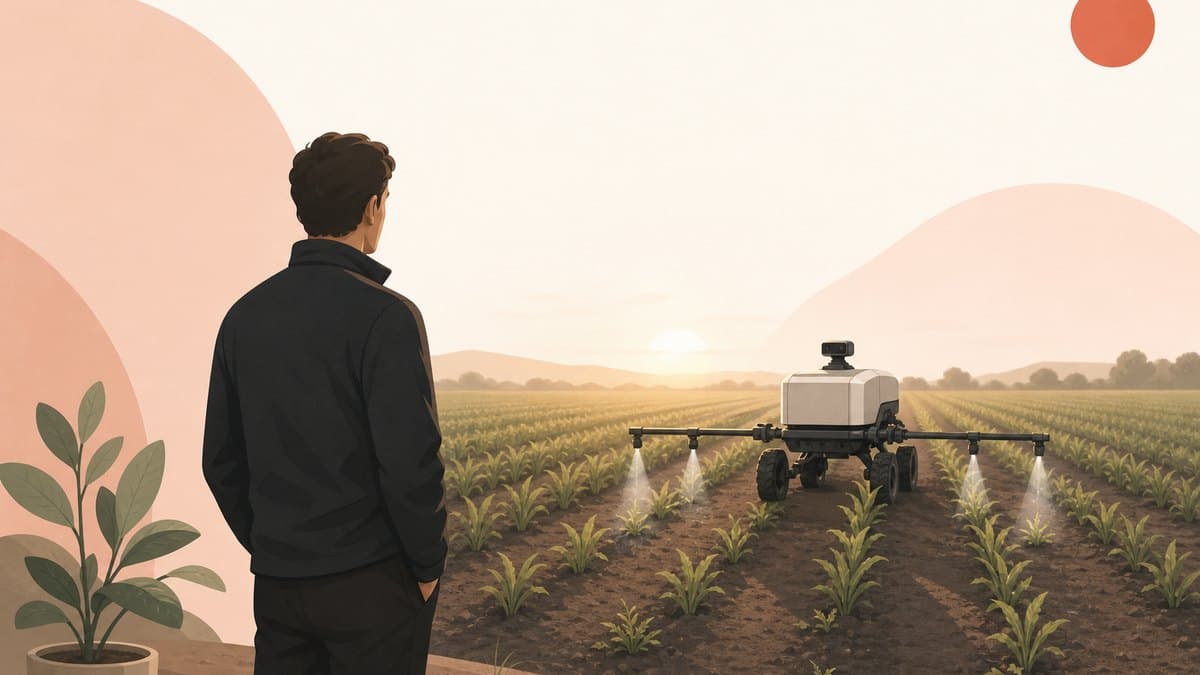
Table of contents
- Why AI in agriculture has a buyer: the resistance loop
- What AI in agriculture actually does today
- The eight jobs AI in agriculture actually does
- How much does AI in agriculture actually save?
- What goes wrong: the seed bank problem
- Why AI in agriculture is defensible: one season, one experiment
- The buyer is conservative and the unit of proof is the acre
- Start where the AI only has to see
- Data ownership, safety, and compliance in AI agriculture
- The case against building AI in agriculture
- What to do this week
- Sources
- Frequently asked questions
AI in agriculture means using machine perception to make decisions per plant that used to be made per field. A camera on a sprayer boom identifies a weed while the machine is moving, and one nozzle fires on that weed instead of coating the whole acre. The yield models, the drone imagery, and the agronomy assistants all arrange themselves around that single change: the unit of decision got smaller than the field.
This is one of the few AI markets where you can check the claims rather than argue about a forecast. Optical spot spraying has been sold commercially since the 1990s, the camera systems that can tell a weed from the crop growing around it have been on the market since 2021, land grant universities have run field trials on them including one that ran three seasons, and the results are public. That record is worth more to a founder than any market projection, because it shows both how large the prize is and exactly where the technology disappoints.
Y Combinator published a request for startups on AI for low-pesticide agriculture that states the thesis cleanly. The gap between that thesis and the published field data is where the actual company is.
Why AI in agriculture has a buyer: the resistance loop
The problem is a treadmill rather than a shortage. YC describes it in one line:
"Farmers are stuck in a bad loop. Use more chemicals, get diminishing results, pay more, and then take on more risk."
The biology under that loop is documented rather than rhetorical. The International Herbicide-Resistant Weed Database, maintained by weed scientists worldwide, currently records 275 weed species that have evolved herbicide resistance, across 548 unique species-by-site-of-action cases. Weeds have now evolved resistance to 21 of the 31 known herbicide sites of action and to 168 individual herbicides, in 102 crops across 76 countries.
Two things follow for a founder, and they point in the same direction.
The first is that the incumbent product degrades on its own. Almost no software market works this way. A spreadsheet does not get worse because customers used it last year, but a herbicide does, because the target population is evolving against it. That means demand for an alternative is not something you have to manufacture through marketing. It arrives on a schedule set by biology.
The second is that the usual replacement, new chemistry, is slow and expensive to develop, which is why the substitute has to come from a different direction. Two directions are open now. One is applying less of the existing chemistry with far better aim. The other is replacing classes of it outright:
"Microbes, peptides, RNA-based solutions, these aren't science fiction anymore. They can replace entire classes of synthetic chemicals."
There is also a market-risk layer that founders tend to either ignore or overstate. YC notes that "Pesticide residues are everywhere, in food, in water, in soil." The regulatory status of the most prominent example is genuinely unsettled: the World Health Organization's International Agency for Research on Cancer classified glyphosate as probably carcinogenic to humans (Group 2A) in 2015, while the US Environmental Protection Agency concluded it is not likely to be carcinogenic to humans and the European Food Safety Authority found it unlikely to pose a carcinogenic hazard. That standing is still moving: in June 2022 the US Court of Appeals for the Ninth Circuit vacated the human health portion of the EPA's evaluation, and the agency says it is updating its assessment of the carcinogenic potential of glyphosate.
The founder move here is not to take a side in the toxicology. It is to notice that a major input has contested regulatory standing in multiple jurisdictions, and that customers, retailers, and insurers price that uncertainty even when regulators have not resolved it. Reduced-input products get bought partly as a hedge, which is a different and more durable buying reason than cost savings alone.
What AI in agriculture actually does today
AI in agriculture today does three things at commercial scale: it tells green from brown, it tells one green plant from another, and it fires a nozzle on the result. Everything else in the category is still a recommendation with a human in between, and knowing which rung a job sits on keeps you from pitching a solved problem or an unsolved one.
The first rung is what Iowa State University extension calls green versus brown: the system distinguishes any green plant from bare soil or crop residue. This works on fallow ground before the crop emerges, and it is comparatively easy, because anything green is a target.
The second rung is green versus green: the system distinguishes a weed from the crop growing around it, and sprays only the weed. This is the commercially meaningful one and much harder, because the model has to tell one plant species from another at speed, in variable light, on a moving boom.
Both rungs are perception:
"AI can now see. It can identify individual weeds and pests in real time."
The rung above perception is actuation, and this is where agriculture is genuinely ahead of most of the physical economy:
"Robotics can now act with precision, treating one plant instead of blanketing an entire field."
That is not a small claim, and it holds up. John Deere reports that its See and Spray system scans over 2,500 square feet per second at up to 15 miles per hour, identifying weeds and triggering individual nozzles as the sprayer moves. The reason agriculture got here before, say, general-purpose robotics is that the action is trivial once perception works. The action is a valve: a solenoid on each nozzle body, and the hard part is deciding when to open it rather than opening it. All the intelligence lives in the seeing, and none of it lives in dexterity. That is the structural reason this vertical produced deployed machines while harder manipulation problems are still in the lab, and it is the sharpest lesson to carry into other physical AI markets. Find the job where a solved perception problem sits in front of a trivial action.
The eight jobs AI in agriculture actually does
Most overviews of the category list applications without saying which ones you can actually buy today. Here is the same list with a maturity read attached, because for a founder the maturity is the whole decision.
- Precision spraying. Commercially deployed at scale, with independent university trials behind it. This is the one job on the list sold as an autonomous action.
- Weed and pest identification. Deployed, and the perception layer sitting underneath most of the rest. This is where the training data is hardest to get and therefore most valuable to own.
- Disease detection from imagery. Deployed as advice rather than action. The model flags a suspected problem and a grower or agronomist decides what to do about it.
- Yield prediction. Limited by regional data rather than by model architecture. A model fit to one region soil, weather, and variety history does not transfer cleanly to another.
- Irrigation scheduling. The binding constraint is sensor coverage and water data, not the quality of the model on top of it.
- Soil and nutrient mapping. Advisory, and usually sold through agronomists rather than direct to growers, which makes distribution the hard part rather than the science.
- Equipment autonomy. Held back by liability and certification more than by perception. The machine can often see well enough before it is allowed to decide.
- Biological product design. Using models to help design the microbial, peptide, and RNA products that replace chemistry instead of aiming it. The longest development cycle on this list and the largest prize.
Only the first of those is sold as an autonomous action. Everything else is a recommendation with a human between the model and the field, and that boundary is the single most important thing to establish before picking which job to build on.
How much does AI in agriculture actually save?
The most useful number in this market is a spread, not an average.
Start with the vendor. Deere reported that See and Spray was used across more than five million acres during the 2025 season, and that customers reduced non-residual herbicide use by an average of nearly 50 percent, saving close to 31 million gallons of herbicide mix. That is a real deployment at real scale, and it is also a number produced by the company selling the product.
Now the independent work, which is more interesting.
A three-year field trial in soybeans by the University of Arkansas System Division of Agriculture found the technology allowed a 43 to 59 percent reduction in post-emergence herbicide use compared with broadcast application, measured at its lowest sensitivity setting.
An Iowa State University extension study went further and published the per-field spread. Across five fields, herbicide savings were 90.6, 87.6, 87.2, 71.2, and 43.9 percent. The average was 76 percent product savings, worth roughly $6,500 in total, or about $15.70 per acre. The study's explanation for the spread is one sentence long and is the whole story: savings were directly influenced by the initial weed pressure in the field.
The same commercial system, run across five fields in a single season, delivered 90.6 percent savings on one and 43.9 percent on another. Iowa State's explanation is the weed pressure the machine started with: the technology did not vary, the customer's field did.
This has three consequences that apply well beyond agriculture.
Your ROI is a distribution, not a number. Any vendor claim of the form up to 95 percent is simultaneously true and useless, because the top of the range describes the customer who needed the product least. A clean field saves the most chemical precisely because there was the least weed to spray. If you sell the maximum, your best-case customer is your worst-case reference.
The variance is the product problem, not a disclosure problem. The work is not getting the ceiling higher. It is raising the floor on the fields that perform worst, which are the weedy, high-pressure, badly drained acres where the farmer's pain is largest and your savings are smallest. Whoever narrows that spread owns the category.
Underwrite the range instead of hiding it. If you know savings correlate with weed pressure, you can measure weed pressure and predict the outcome before you sell. That turns a variable-value product into a segmented one, and it lets you quote honestly to the fields where you win.
What goes wrong: the seed bank problem
The Arkansas trial contains a finding that should be on the wall of any team building AI for a physical system. Running the technology at a low sensitivity setting, which maximizes visible herbicide savings, increased the Palmer amaranth pigweed population by 280 percent each year, because only larger weeds got sprayed and the escapes set seed and built up the soil seed bank. That is the same low sensitivity regime that produced the 43 to 59 percent savings above. The headline number and the weed penalty are not two findings, they are one finding read two ways.
The trap is more seductive than it sounds, because the in-season scoreboard looked good on both axes. At that setting the Arkansas researchers also observed a slight yield increase of about 4 bushels of soybean per acre, likely from reduced herbicide injury to the crop. Less chemical and more yield this season, with the whole bill deferred into next season's weed pressure. The system optimized exactly what it was told to optimize. Spray less. It saved chemical this season by letting more weeds go untreated, and those weeds set seed, and next season starts worse. The metric improved while the outcome the customer actually needs, weed control across years, got worse.
This is the evaluation problem in its most physical form. The measurable in-season metric, chemical saved per acre, is not the customer's real objective, which is a manageable weed population over a rotation. Any agriculture product that reports savings without reporting escapes and seed bank consequences is selling a number that will turn on its customer in about two years, and farmers talk to each other.
The general form of the lesson: when your metric is cheap to measure and your outcome takes years to appear, you will be rewarded for optimizing the metric right up until your customers discover the difference. Build the slower measurement into the product before the market builds it into your reputation.
Why AI in agriculture is defensible: one season, one experiment
The obvious complaint about AI in agriculture is that a growing season is one experiment. You get roughly one iteration per year per geography, where a software company gets one per week. That is real, and it is also the source of the defensibility.
This is the textbook case of the data-poor domain: hard to start, and hard to follow you into. The data required, images of specific weed species in specific crops under local light and soil conditions, does not exist on the internet in usable form. Nobody scraped it, because it was never posted. It has to be collected acre by acre, season by season, and it is regional: a model trained on Iowa corn does not transfer cleanly to Brazilian soy or Californian almonds.
The consequence is a genuine moat of a kind that has become rare. In data-rich domains, a competitor with a good model and a credit card catches up in a quarter. Here, a competitor starting today needs seasons, and seasons cannot be bought with funding. Every acre you operate on compounds into an asset that a better-capitalized entrant cannot simply purchase.
The corollary is that the first product should be designed to collect data even when it is not yet good enough to act on it. A camera rig that records and recommends while a human sprays is a weaker product than an autonomous system, and it is a far better data acquisition strategy, because it can ship two seasons earlier and every one of those acres feeds the model that eventually earns the right to act.
The buyer is conservative and the unit of proof is the acre
Agricultural buyers get described as slow adopters, which is condescending and wrong. They are correctly calibrated. A farmer who tries your product and loses a field does not get that field back, and the downside is asymmetric in a way it simply is not for a software buyer who can churn next month.
So the sale is not made on a demo. It is made on a number the buyer already uses to run the business, which is dollars per acre. Every good pitch in this market resolves to a per-acre figure the farmer can put next to their own input costs. The Iowa State study's $15.70 per acre is more persuasive than any percentage, because per-acre is the native unit of the customer's own accounting.
Deere took this to its logical conclusion in 2025 with an Application Savings Guarantee: customers pay for See and Spray through a per-acre fee, $1 per fallow acre or $5 per in-crop acre, and pay it on the acres the technology left unsprayed. The vendor gets paid out of measured savings rather than in advance of promised ones.
For a founder that is worth studying as pricing design rather than as a competitive threat. Outcome-linked pricing does three things at once in a conservative market. It removes the buyer's downside, which is the actual objection. It forces you to instrument the outcome, which you needed to do anyway. And it makes your revenue an honest function of the value distribution discussed above, which means a weedy field that saves less also costs the customer less, and the pricing stops fighting the physics.
The catch is that you can only offer it if you can measure it. If your product cannot produce a defensible unsprayed-acre count, you cannot price this way, and you are back to selling a promise to someone who has been sold promises for forty years.
Start where the AI only has to see
The lowest-risk entry into a physical market is the layer where being wrong is cheap. YC made this argument in a separate request for startups about AI guidance for physical work, noting that across field services, manufacturing, and healthcare, AI cannot yet act in the world, and that:
"What it can do is see, reason, and guide the human who does."
Agriculture is slightly ahead of that description for the one narrow task of spraying, and squarely inside it for everything else: scouting, disease identification, irrigation calls, harvest timing, resistance management, and compliance. In all of those, a wrong recommendation costs a conversation. A wrong actuation costs a crop.
That asymmetry should shape the first version of the product. Ship the system that sees and advises, earn the right to act, and use the advisory period to accumulate the seasons of proprietary data that make the acting version defensible. This is the same sequencing that works in field service and other physical-economy verticals, and agriculture rewards it more than most because the cost of a bad autonomous decision is measured in acres.
Data ownership, safety, and compliance in AI agriculture
The security and governance questions in this market are not paperwork. They are product decisions, and getting them wrong is how a technically excellent agriculture company loses its customers.
Field data ownership has to be settled explicitly and early. Yield maps, application records, and field boundaries are commercially sensitive, they reveal farm profitability, and farmers have grown justifiably wary about where they end up. Decide in writing what you collect, what you retain, whether it trains models used for other customers, and what happens to it if you are acquired. Say it before you are asked.
Resistance stewardship belongs in the product, not the terms of service. Given what the Arkansas trial showed, a product that lets a customer dial settings toward short-term savings and long-term resistance is a product that will eventually be blamed for the resistance. Constrain the settings, or at minimum report the tradeoff in the interface where the decision is made.
The autonomy boundary needs to be explicit. Agricultural equipment is heavy, fast, and increasingly operating near people, roads, and livestock. Define exactly what the machine may do unsupervised, what requires a human, and how it fails safe when perception degrades in dust, rain, or low light. That boundary is a safety control, and it should be as legible to the customer as it is to you.
Application records are regulated evidence. Pesticide application is subject to label compliance and, in many jurisdictions, drift liability toward neighboring crops. A system that decides where chemical goes is generating a record that may be examined by a regulator or a plaintiff. Build the audit trail as though it will be read adversarially, because eventually it will be.
Founders coming from software tend to treat these as later-stage concerns. In agriculture they are gating: the conservative buyer described above is conservative about exactly these things, and answering them well is a sales advantage rather than a tax.
The case against building AI in agriculture
Three reasons not to do it, stated plainly, because a founder who has not considered them is not ready.
Cycle time is brutal. One season is one experiment. A product loop that runs weekly in software runs annually here, and two disappointing seasons consume most of a seed round with little to show.
Capital intensity is real if you touch hardware. Building machines means inventory, service, and working capital, in a customer base that is itself seasonal and credit-constrained. The software-only wedges are correspondingly more attractive for a small team.
Deere is a formidable incumbent in row crops specifically, with the machine, the dealer network, and the financing relationship. Competing head-on for the corn and soybean sprayer is not a plan. Specialty crops, retrofit systems for the installed base of machines nobody is replacing this year, and the data and compliance layers around the equipment are where a small team has room.
Set against that is the point YC ends on, which is the reason this is worth the difficulty:
"If you can lower costs and increase yields at the same time, adoption isn't slow, it's explosive."
That claim is now partly testable. Deere commissioned soybean trials across seven states, run by third-party researchers and universities, which reported an average yield increase of 2 bushels per acre with an upper range of 4.8 from targeted rather than broadcast application, a result Deere links to reduced crop injury. Cost down and yield up in the same pass is the combination that moves conservative buyers, and it is why YC concludes that a company that could "cut pesticide use by 90% and help farmers grow more food, that's not just a good business, that's a generational company."
What to do this week
- Pick one crop and one job, not agriculture. The economics differ per crop because the machine and the labor cost differ per crop. Vegetables, orchards, and specialty crops are underserved precisely because they are not corn.
- Get the per-acre number for your job before you build anything. What does the current practice cost per acre, and what is the realistic range you can save? If you cannot state both, you do not yet have a business, you have an interest.
- Model your value as a distribution. Estimate the best case, worst case, and what drives the spread. Then decide whether your first product raises the floor or the ceiling, and prefer the floor.
- Design the first version to see and recommend, not to act. Ship it two seasons earlier, and treat every acre it observes as the data asset that funds the autonomous version.
- Write down your field data policy before your first customer asks. What you collect, what you retain, whether it trains shared models, and what happens on acquisition.
- Find a grower who will let you run one field this season. One real field this year beats a better plan next year, because the calendar does not care how good your deck is.
The pattern underneath all of this is the one that runs through the AI for startups pillar: the opportunity sits where a hard perception problem just became tractable and sits in front of a simple action, in a market where the data has to be earned rather than downloaded. AI in agriculture happens to be the clearest current example, which is why it is worth studying even if you never build a sprayer.
If you want the operating system for running a company this way, that is what I teach in AI Operating System for Startups.
Sources
- AI for Low-Pesticide Agriculture, Y Combinator's request for startups, the source this article distills.
- AI Guidance for Physical Work, Y Combinator, on the see-and-guide layer that precedes autonomy in physical work.
- International Herbicide-Resistant Weed Database for the current counts of herbicide-resistant weed species, cases, and affected sites of action.
- John Deere's November 2025 release on See and Spray for the five million acres, the near 50 percent average reduction, the scanning specification, the Application Savings Guarantee pricing, and the commissioned yield trials.
- University of Arkansas System Division of Agriculture for the independent three-year soybean trial, the 43 to 59 percent post-emergence range, and the 280 percent Palmer amaranth finding.
- Iowa State University extension crop news for the per-field savings spread, the $15.70 per acre figure, and the green-versus-brown and green-versus-green capability distinction.
- Regulatory positions on glyphosate: IARC, the US EPA, and EFSA.
Frequently asked questions
What is AI in agriculture?
AI in agriculture means using machine perception to make decisions per plant that used to be made per field. The clearest working example is precision spraying: cameras mounted on a sprayer boom identify weeds in real time while the machine moves, and individual nozzles fire only where a weed is, instead of coating the entire acre. The same pattern shows up in yield prediction, disease detection, irrigation scheduling, and equipment autonomy, but spraying is the one with commercial deployment and independent field trials behind it. The broader category also includes AI applied to the biology itself, where models help design microbial, peptide, and RNA-based products meant to replace classes of synthetic chemistry.
How much does AI actually reduce pesticide use?
Less than vendor headlines suggest, and with enormous variation between fields. John Deere reported that customers using See and Spray across more than five million acres in 2025 cut non-residual herbicide use by an average of nearly 50 percent. Independent work is the more useful record. A three-year University of Arkansas trial in soybeans found reductions of 43 to 59 percent in post-emergence herbicide, measured at the system's lowest sensitivity setting. An Iowa State field study across five fields found savings of 90.6, 87.6, 87.2, 71.2, and 43.9 percent. The average was 76 percent of product, worth about $15.70 per acre, and the study stated plainly that savings were directly influenced by the initial weed pressure in the field. In other words the honest answer is a range, and the range is driven by how weedy the field was to begin with.
Can a startup compete in agriculture against John Deere?
Not by building a better sprayer, but that is not the only way in. Deere owns the machine and the financing relationship, and reaches the customer through an exclusive network of independent dealers, which together is close to unassailable for row crop equipment. What it does not own is every crop, every geography, or every job. Specialty crops, orchards, and vegetables are poorly served because the machine economics differ per crop. Retrofit vision systems that upgrade existing sprayers reach the far larger installed base of machines nobody is replacing this year. Agronomic data that survives across seasons, resistance monitoring, and compliance reporting are software problems where incumbency in steel does not transfer. The rule is to pick the job where the hardware is already in the field and the missing piece is perception, judgment, or record keeping.
What are the risks of building an AI agriculture startup?
The cycle time and the liability. A growing season is one experiment, so a product loop that takes a week in software takes a year here, and two bad seasons is most of a seed round. Adoption is correspondingly slow because a farmer who tries your product and loses a field does not get that field back. On top of that sit real liabilities: spray drift onto a neighbor's crop, pesticide registration and label compliance, autonomy operating near people and roads, and ownership of field data that farmers increasingly treat as their own asset. None of these are reasons to avoid the market. They are reasons to design the first product so it fails cheaply, which usually means starting where the system only has to see and recommend rather than act.
Build your AI Operating System
A practical course to grow with AI, build internal tools, and operate safely. Join the waitlist and you'll be first in when the course opens.