How to build an AI-native company

Cicero Campelo, CISSP
June 16, 2026 · 7 min read
Part of our guide to AI for startups.
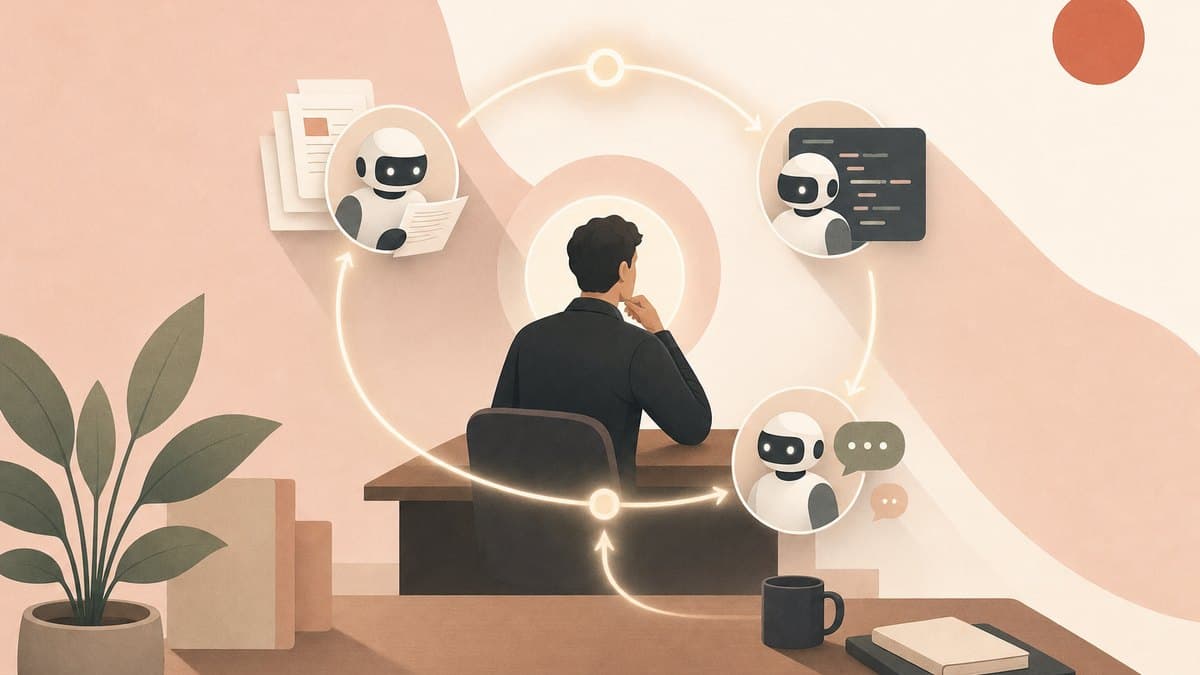
Table of contents
An AI-native company is one where AI agents are wired into the actual work, not bolted on as a side tool, and the org is redrawn around them. In a Stanford CS 153 lecture, YC CEO Garry Tan and YC managing partner Diana Hu argued this is why a six-person team can now hit ten million dollars in revenue, and why one person at a terminal can do the work of 500 to 1,000 people, the same leverage behind the rise of the solo founder.
The claim is big. What matters for founders is the structure underneath it. Here is the playbook, and where a security-minded founder should slow down.
An AI-native company runs as a closed loop
Diana Hu's core idea comes from control systems. Most companies run as an open loop: people make decisions, the results come back slowly, and a lot of information is lost along the way. It lives in people's heads, in side DMs, in meeting notes nobody wrote down, in vibes. As errors pile up, an open loop drifts off the rails.
A closed loop feeds the output back into the system fast enough to keep error in check. An AI-native company does this by giving an agent read access to the artifacts the company produces, then letting it surface what to do next. Connect an agent to your codebase, your chat, and your recorded standups, and it can suggest the next fixes and ship them back into the work. The company starts to self-heal.
That is the mechanism behind the revenue-per-employee numbers YC is seeing: roughly one to two million dollars of revenue per person at the startups doing this well, which they put at about ten times a typical SaaS company. When YC applied the same pattern to its own engineering team, Diana Hu said they cut sprint time in half and produced ten times the work.
The three roles that replace the org chart
If agents handle the routing of information, the middle of the org chart thins out. That is the same bet Jack Dorsey and Roelof Botha describe in Block's "From Hierarchy to Intelligence": fewer permanent management layers, work organized around owners instead. YC frames the AI-native company as three roles:
- Individual contributors who ship. Everyone builds, including non-technical people. A salesperson can build and automate their own pipeline of calls and follow-ups.
- The DRI, the directly responsible individual, an Apple term for the single owner of an outcome. The DRI orchestrates the ICs and the agents to hit a goal, and is often the founder.
- The AI-native founder, who lives at the edge of the tooling. Agentic coding only started working well in late 2025, Diana Hu noted; a founder still operating at last year's copilot level is, as the talk put it bluntly, "not going to make it." That question of what a founder should actually do first is exactly what five founders answer differently in how to start a startup, verbatim and timestamped.
The throughline is that humans and taste stay central. This is humans in concert with agents, not a company with no people.
Give agents read access to everything, carefully
The closed loop depends on one thing that should make any security person pause: the agent needs read access to nearly every artifact the company produces. That is exactly what makes it powerful, and exactly where the risk concentrates.
As a CISSP, this is the part I would not rush. Read access to "everything" means one system can now see your source code, your customer data, your internal strategy, and your secrets. Before you wire that up:
- Scope the access. Least privilege still applies to agents. Give each agent the narrowest read scope that does the job, not a blanket admin token.
- Keep secrets out of the context window. API keys and credentials in a prompt are credentials in a log.
- Log and review what the agent reads and does. Garry Tan's point that 10 to 20 percent of a finance org is compliance is not a joke about agents; it is the warning. Audit is the cost of a messy system that still has to work.
Founders building agents into regulated workflows are already living this. The companies on our AI for security hub exist because access, audit, and trust are where these systems break first.
Taste and evals are the part you cannot delegate
If shipping code is going to zero, the durable skill is taste: knowing what is good, and what your customer actually wants. Diana Hu's practical version of taste is evals.
Generic benchmarks like MMLU do not tell you whether your product works. The only judge that counts is whether the user wanted the result. So the human job is to read the traces, the real inputs and outputs of your agents, label what went wrong, and feed that back in. Did the agent follow the instructions? Was the answer correct? Did it keep the customer's trust? Did it hit the business goal? Those are your evals, and they are specific to your domain. Nobody can hand them to you.
This is the same loop Garry Tan runs on the code itself. We broke down that side of his process, running agents like an engineering team with plan, review, and a ship gate, in how to build software with AI agents. The company-level version is the same discipline pointed at outcomes instead of pull requests.
How to break in: become the forward-deployed engineer
The opening is not a flashy demo. It is a painful workflow nobody has automated. YC's pattern for the startups going from zero to eight figures in about a year is to pick one such workflow and go deep:
- Salient builds AI for loan servicing and won real banks.
- Happy Robot put voice agents into freight and logistics, embedding with the people coordinating truckers, and raised a Series B.
- Reducto does document processing, the unglamorous layer that makes every other agent's memory and retrieval better.
The founders behind these did not arrive as domain experts. Diana Hu's advice is to go undercover: shadow or take the job, learn the messy reality of phone calls, spreadsheets, and email, then build the agents that absorb it. If you end up hiring for that work rather than doing it yourself, the founder's guide to the forward deployed engineer covers what the role costs per logo and when it is worth it. Garry Tan's target is the old instinct to play it small. When an idea in a meeting gets too ambitious, someone says "let's not boil the ocean." His answer now is to boil the ocean: if one person can do the work of hundreds, the safe-sized plan is the wrong plan.
Diana Hu pointed to Anthropic's data on where AI is actually being used: heavy adoption in coding, and wide-open space in back office, finance, customer service, and security. That white space is where the next set of companies gets built, by founders who pick a domain and out-execute the incumbents who are still moving information by hand.
What to do this week
- Map your own open loops. Where does information go to die: unwritten decisions, side DMs, meetings with no notes? Those are the first places to close the loop.
- Stand up a small company brain. Give one agent scoped, read-only access to your codebase and your team chat, and ask it for the next three things to fix.
- Set the access rules before you scale them. Decide what an agent may read, keep secrets out of the prompt, and turn on logging from day one.
- Write three evals from real traces. Pull actual agent inputs and outputs, label what was good or bad, and feed that judgment back in.
- Pick one painful workflow to go undercover on. Shadow the job long enough to build the agent that does it.
The lecture's closing line was that the one-person frontier lab can now become a one-person company, and that it could be you. The structure to get there is a closed loop, a few clear owners, and taste you keep for yourself.
If you want that structure as a system rather than a set of notes, that is what we teach in the AI Operating System for Startups. For the internal plumbing that powers the loop, the shared context, the tool registry, and self-improving skills, see internal AI infrastructure for startups. For the services-business version of this, where AI delivers the outcome itself, see how to build a service-as-software company. For the aggressive-adoption mindset behind it, see why a startup CEO went all in on AI. For the same model pushed to its extreme in finance, see what AI hedge funds teach lean founders.
Sources
- Garry Tan and Diana Hu at Stanford CS 153, the lecture this article distills.
- Profiles: Garry Tan and Diana Hu on Y Combinator. Garry Tan is YC's CEO and earlier founded Posterous (acquired by Twitter) and the venture firm Initialized Capital. Diana Hu co-founded the AR startup Escher Reality, acquired by Niantic, and later ran Niantic's AR platform team.
- The flat-org thesis: Jack Dorsey and Roelof Botha, "From Hierarchy to Intelligence" (Block).
- Company examples: Salient (loan servicing, a16z-led round), Happy Robot (freight logistics), and Reducto (document processing).
- Adoption data: Anthropic Economic Index.
Frequently asked questions
What is an AI-native company?
An AI-native company is one where agents are built into the actual work, not bolted on as a side tool. YC's Diana Hu describes it as running the company as a closed loop: agents have read access to the artifacts a team produces (code, docs, meeting notes, messages) and feed that context back into decisions and self-healing systems. The result YC reports from its portfolio is small teams reaching revenue that used to take four or five years and many more people.
What is the difference between an open-loop and a closed-loop company?
In an open-loop company, information lives in people's heads, side DMs, and unwritten meeting notes, so feedback is slow and lossy and errors accumulate. A closed-loop company wires agents into the flow of work: they read the full state, surface what to do next, and tighten the gap between a decision and its result. Diana Hu borrows the idea from control systems, where a closed loop keeps error in check instead of letting it drift off the rails.
Do AI-native companies still need to hire people?
Yes, but the shape of the team changes. YC describes three roles: individual contributors who now ship with agents (including non-technical people), a directly responsible individual who owns an outcome and orchestrates the work, and an AI-native founder who lives at the edge of the tooling. Garry Tan and Diana Hu are clear that humans and taste still matter; the work is humans in concert with agents, not agents alone.
How do startups compete with incumbents using AI agents?
By going deep on one painful workflow instead of demoing generic AI. YC points to founders who act as forward-deployed engineers: they shadow or take the job, learn the messy domain end to end, then build agents that automate the repetitive work. Salient did it in loan servicing, Happy Robot in freight logistics, and Reducto in document processing, each reaching eight figures in revenue within about a year.
Build your AI Operating System
A practical course to grow with AI, build internal tools, and operate safely. Join the waitlist and you'll be first in when the course opens.