Solo founder: build like a team with AI
Cicero Campelo, CISSP
June 24, 2026 · 8 min read
Part of our guide to AI for startups.
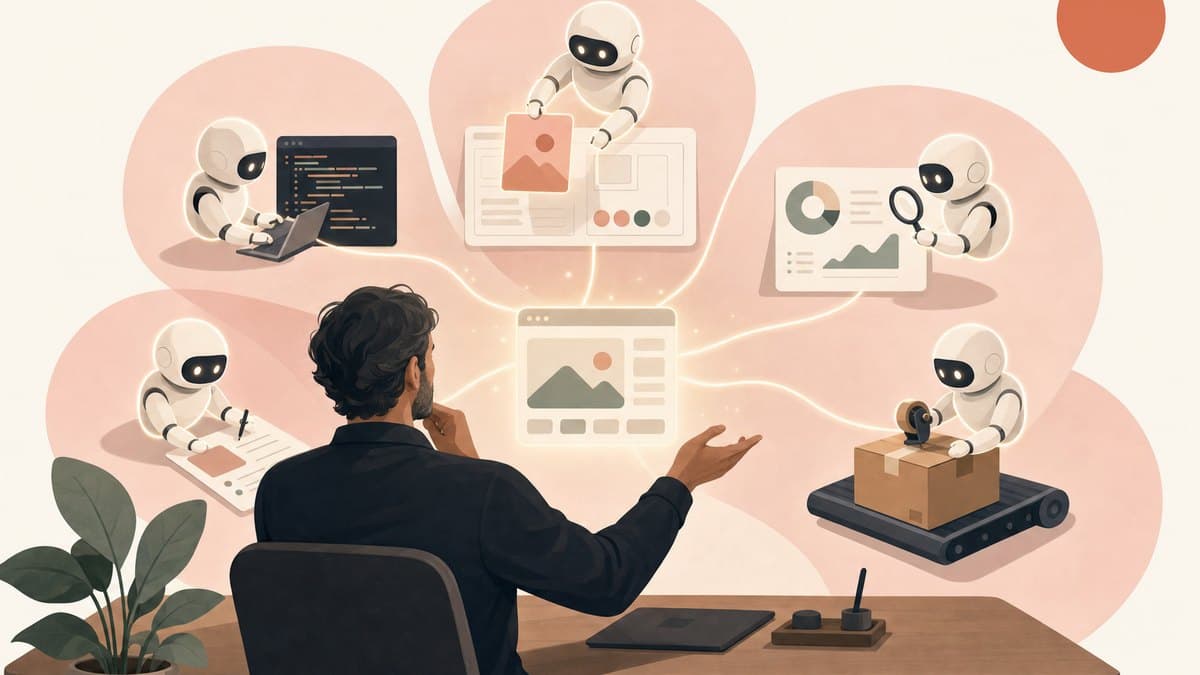
Table of contents
For most of startup history, "solo founder" was a polite way of saying short-handed. No one to split the work, no one to cover your weak side, no one to talk you off a ledge at 2am. That math is changing. In a recent episode of Y Combinator's The Lightcone, Bryant Chou, who co-founded Webflow and ran its engineering for over a decade, showed what a solo founder can do now with AI, and YC's Garry Tan gave it a name: the age of the solo founder. The catch is that it rewards a specific kind of person, and it is probably not who you think.
The age of the solo founder
Tan's framing is blunt. With AI, an experienced builder can clone themselves, not once but hundreds, even a thousand, times over. He describes shipping on the order of four to five million lines of code by treating his own skills and taste as something he can replicate at that scale, doing in days what a typical engineer would take a year to do. "This is the age of the 40-year-old solo founder," he says. "You don't have to be 40, you just have to have taste."
The contrast he draws is with Parker Conrad, who rebuilt Rippling the old way: two years in a cave, a team of five to ten people writing code in a basement, before launching. The work was real and the result was huge, but it took a team and it took years. The point is not that AI makes that effort unnecessary. It is that a single experienced person can now compress it. This is also why the question of whether AI will take your job reads differently for founders: the same shift that thins out headcount is what lets one person start a company at all. Chou is the live example. Back in YC with a new startup, Ploy, he is rebuilding the kind of product that took Webflow a large team and many years, and he is doing it as a solo founder.
Why experience became the edge
Here is the part founders skip. If the model is the great equalizer, then everyone gets the same execution superpower, which means execution stops being the differentiator. What is left is knowing what to build and how to steer the tool. Chou puts it directly: "You need to have a certain amount of expertise to know what to do with this boundless intelligence that's imbued in the model." The people who win are the ones who can focus that intelligence, and focus comes from experience.
His own background is the proof. He was Webflow's CTO, but he also led its marketing and started its sales team, and his background includes time at Intuit. So when he builds Ploy, a marketing platform, he is pointing the model at work he has done firsthand for years: building, marketing, and selling web products. He describes it as standing outside with a magnifying glass under the blazing sun, focusing all of his experience, his knowledge of the customer and their buying patterns, onto one point until it catches fire. That is the whole thesis: AI multiplies the edge you already have, it does not hand you an edge you lack. A brilliant generalist with the same model and no domain scars will lose to the operator who knows exactly where the problems are buried. The same logic now reaches people who cannot code at all: with an AI app builder, a domain expert can turn their knowledge into a shipped product without an engineer.
Find the market only you can win
This is why "what should I build" is the wrong question for a solo founder. The right one is "where is my unfair advantage." The founders who struggle, Tan notes, are often great technologists who cannot get anyone to use the thing. The ones who win go straight to the part of the idea maze they already know cold, skipping the years of wandering a newcomer has to do.
Chou's rule for picking a market is to ignore the crowded, trendy fights and find a real customer with a true pain you understand. He is deliberately not selling to software engineers, who he calls some of the worst customers to sell to because they switch tools on a whim and compete on price. He picks small businesses and startups with a concrete problem, because that is where his experience converts into product. For a solo founder, the market you choose is the single highest-leverage decision you make, because you do not have a team to brute-force your way out of the wrong one. Five founders describe where their own idea actually came from, and they do not agree on the order of operations either.
Automate yourself, not just your code
Being a solo founder with AI is not only about writing code faster. The bigger win is automating the company around you. Chou runs his go-to-market on autopilot: every sales call is transcribed and pushed into the CRM, proposals are drafted automatically, follow-up emails are scheduled, and a coding agent has access to everything. The result, he says, is that one person can take on far more, far faster, and still feel like there is room to think. He calls it a level of abundance people rarely mention when they talk about AI.
That is the difference between using AI as a tool and building a company that runs on it. The mechanics of that stack, one place for your context, a library of tools your agents can call, and loops that improve themselves, are what I covered in internal AI infrastructure for startups. For a solo founder it is not a nice-to-have, it is the thing that turns one person into an operation. The operational half of that load, the payroll, compliance, and routine admin that used to force an early hire, is now what an AI co-founder is built to absorb. This is the practical edge of the AI-native company taken to its limit: a one-person startup that performs like a company many times its size. The number that captures that gap is revenue per employee, and it is climbing fast in the AI era.
Taste is the part you cannot prompt
If AI hands everyone the same factory, your taste is the product. Chou's phrase for it is that these models are "the factories for human creativity," but the creativity still has to come from you. Ploy fights AI slop not by hoping the model behaves, but by feeding it thousands of hand-curated examples of good web design so its output carries a point of view instead of the model's defaults. Without that opinion, you get the generic look everyone now recognizes as machine-made. The same logic governs product decisions, not just design: as we cover in AI for product managers, AI can synthesize the feedback and draft the spec, but the judgment about what is worth building stays with you. Taste being the product has a limit worth knowing too, because taste is trainable and therefore weak as a moat on its own, which is the argument we work through in why a designer founder's advantage is not taste.
The lesson generalizes. Whatever you build solo, the model gives you a competent average unless you supply the standard. Chou warns against the lazy version: spinning up a hundred pages of content for its own sake will not make Google or a customer trust you. You have to provide real value and tell a coherent story. That judgment, the ability to look at the model's output and know what is excellent versus merely fine, is the same discipline behind moving from vibe coding to agentic engineering: the human supplies the taste and the verification, the model supplies the volume.
What to do this week
- Write down the two or three domains where you have real scar tissue, years of lived experience, not just interest. The overlap with a market need is your founder market fit, and it is where a solo founder should start.
- Pressure-test your current idea. If a sharp generalist with the same models could out-execute you, you are building in someone else's maze. Move to one where your experience is the moat.
- Point AI at the edge you already have instead of faking one you do not. Use it to go deeper and faster in your domain, not to enter a field you have never worked in.
- Automate the company, not just the code. Wire recorded calls into your CRM, set up automatic follow-ups, and give an agent access to your systems, so one person runs like a team.
- Curate your taste. Collect the examples and standards that represent excellent in your field and feed them to your tools, so your output reflects your judgment, not the model's average.
- Pick one customer with a real, specific pain you understand, and build for them. Skip the crowded markets where you have no edge.
The model is the great equalizer on execution, which means your experience is the one thing it cannot copy and hand to a competitor. The age of the solo founder does not reward whoever has the best AI. It rewards whoever has the taste and the scars to aim it. Building the system that lets one experienced person operate like a whole company is exactly what the AI Operating System for Startups is for.
Sources
- The Age Of The 40-Year-Old Solo Founder Is Here (Y Combinator's The Lightcone), the conversation this article distills.
- Profiles: Bryant Chou, co-founder and longtime CTO of Webflow and now founder of Ploy, and Garry Tan, CEO of Y Combinator, who framed the age of the solo founder.
- Background on Webflow's founding (co-founders Vlad and Sergie Magdalin) and Chou's path: First Round Review.
Frequently asked questions
What is a solo founder?
A solo founder, increasingly overlapping with what people call a solopreneur, is someone who starts a company without a co-founder, owning the full range of work a founding team would normally split. Historically this was seen as a disadvantage, since one person had to cover product, engineering, sales, and marketing alone. AI changes the math: with coding agents and automated workflows, a single experienced founder can now produce the output that used to require a team, which is why YC's Garry Tan calls this the age of the solo founder.
Can a solo founder compete with a funded team now?
Yes, if the founder brings deep experience. Garry Tan argues an experienced builder can use AI to clone their own skills hundreds of times over and do in a few days what would take a typical engineer an entire year. His example is Webflow co-founder Bryant Chou, who is rebuilding a marketing platform solo in YC. The caveat is that AI multiplies an existing edge rather than creating one, so a solo founder still needs the domain expertise and taste to steer the tools.
Do you need to be technical to be a solo founder?
Less than before, because models now handle much of the coding. But the bar moves rather than disappears. As Bryant Chou puts it, you need enough expertise to know what to do with the model's boundless intelligence. The scarce skill is judgment: knowing what to build, which market to enter, and what good output looks like. A non-technical founder with deep domain knowledge and taste can now go further than a technical founder with neither.
What is founder market fit and why does it matter for a solo founder?
Founder market fit is the alignment between a founder's hard-won experience and the market they choose to serve. It matters more in the AI era because, when everyone has the same models, your unfair advantage is the domain you already understand. Bryant Chou is a clear case: he led engineering, marketing, and sales at Webflow, so building a marketing platform points AI at years of his own hands-on expertise in building and selling web products. For a solo founder with no team to compensate, choosing a market where you have real founder market fit is the highest-leverage decision you make.
Solo founder vs co-founder: is it better to start alone with AI?
It depends on where your gaps are. If you have deep experience across the range your startup needs, going solo with AI is more viable than ever. If you have a blind spot in a critical area, a co-founder still beats an agent. AI reduces the classic reason to take a co-founder, which was needing another pair of hands to execute, and agents can fill much of the output-and-speed gap now. But a co-founder also brings range, judgment, and someone to share the decisions, which AI does not replace.
Build your AI Operating System
A practical course to grow with AI, build internal tools, and operate safely. Join the waitlist and you'll be first in when the course opens.